DSP&P Passenger Car Research


 Locked

1234

1234
 
|
This post was updated on .
Chris,
[Editing my original post] Enigma is an apt term, given the paucity of print or photographic data during 1874-1876. No argument on the lack of details on all this. I'm going to just focus on the June 16 1874 article I posted and your comments on borrowing CCRR cars. 1870s documentation is so rare that the rosters we have (published or otherwise) are developed by historians like putting together a broken vase, from available newspapers, journals and photos. There is no single early South Park or CCRR roster I've seen--but that doesn't mean one doesn't exist somewhere waiting to be found. At any rate, excursion cars are barely mentioned. Did the South Park borrow cars from the CCRR? Not at the very beginning, that we know. Photos of the South Park 1874-1876 are very rare and photos of excursion cars show them on CCRR rails. For what its worth, maybe that isn't completely true: Consider the early (1875?) image of Morrison--specifically the round-roofed car at the near end of the spur. I've long wondered what this is--an excursion car? 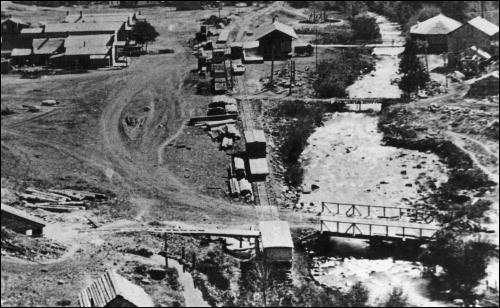 Or is it an early lime car? I know that starting in 1884 only two subsidiaries have excursion cars, the CCRR (6 cars) and the U&N (8 cars) and that count remains fairly stable until the mid-1890s. None for the South Park at that time and, though lacking data, maybe none from 1874 to 1884. So did they borrow cars from the CCRR? Did they need to in 1874-1876? I dunno but am skeptical. Is the June 14th 1874 article accurate or misleading? It does specifically say Hallack was building cars for the South Park. If the reporter was wrong, what does it mean? I don't think it was that Hallack built cars for the CCRR, that doesn't make sense given Golden's skillset. And not mentioning the CCRR may speak to the rivalry between Denver and Golden--or not. But what if the reporter is talking about something other than dedicated cars and what he saw or heard was Hallack building four removable superstructures for existing flatcars? This was a common solution to cut costs and improve equipment usage. If so, those superstructures may have even been placed on non-DSP&P cars. All of these questions have no solid answer and hopefully Ron or another researcher has some detail around these cars in the very early years. On the published rosters, I have some concerns and I know that may be a contentious comment. It's not that modern published rosters are flawed (though errors do occur as data emerges), it is that they often don't provide a lot of notes or citations, and all touch a single moment in time rather than giving a chronological story. I am absolutely convinced information is hiding in the large collections at CRRM, CHS and the U of Wyoming (which recently exposed an 1889 Inventory of UP equipment). Digitized versions of records are rapidly adding to the story. To me the gold standard of modern rosters are Ron Rudnick's Modeling Guides, which give details, citations and analysis. They are a must-own. Ron doesn't touch much on the excursion cars in the Guides but I agree odds are good he has more on this topic for 1874.
Dave Eggleston
Seattle, WA |
|
I'm not sure this is much better, but a bit more resolution. It's spotted next to some sort of loading structure, which isn't where I'd expect to see passenger equipment. It looks like there may be an end platform, but probably just extended end beam. there doesn't appear to be any railing or end door. The car also appears to be pretty short, so not likely to be carrying passengers, except maybe Munchkins. 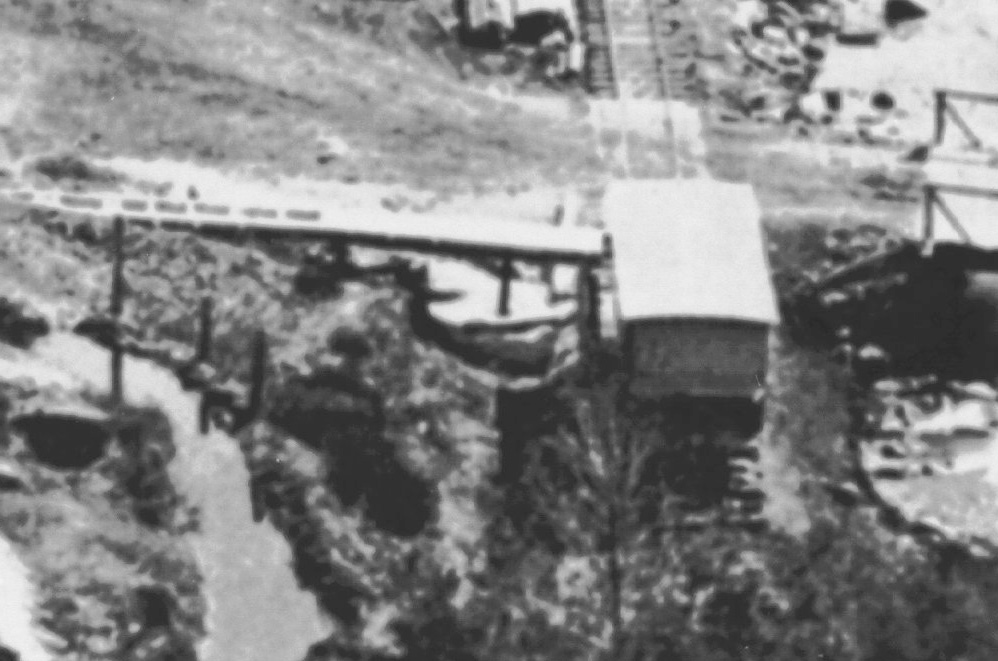
|

|
In reply to this post by Dave Eggleston
Hmmm! Dave, thank you for the thoughtful response.
Food for thought on a cold rainy day.  The lack of visual evidence of DSP&P open excursion cars is a bother(probably only to me  ), the CC on the other hand shows up at Beaver Brook, the opening of Georgetown Depot and opening the switchback line into Central City, all in the 1870's. Dated. No doubt there. ), the CC on the other hand shows up at Beaver Brook, the opening of Georgetown Depot and opening the switchback line into Central City, all in the 1870's. Dated. No doubt there.
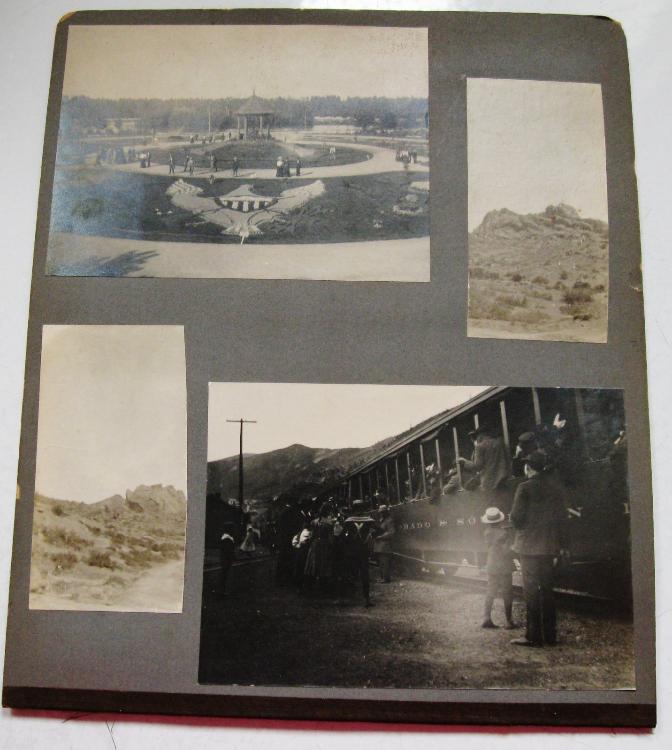
And still in use 4th July 1890 Idaho Springs, after the new open cars built in 1883. About that Flatcar musing of your's: The car usage brought up by Keith at Pitkin.....does raise another thought.  Dow Helmers Historic Alpine Tunnel. 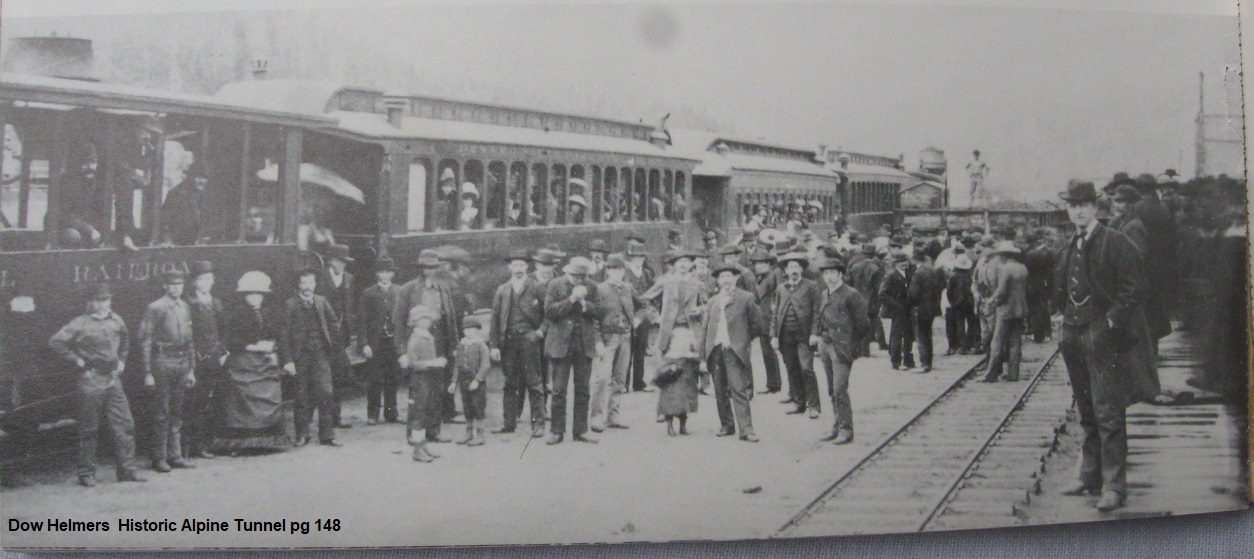 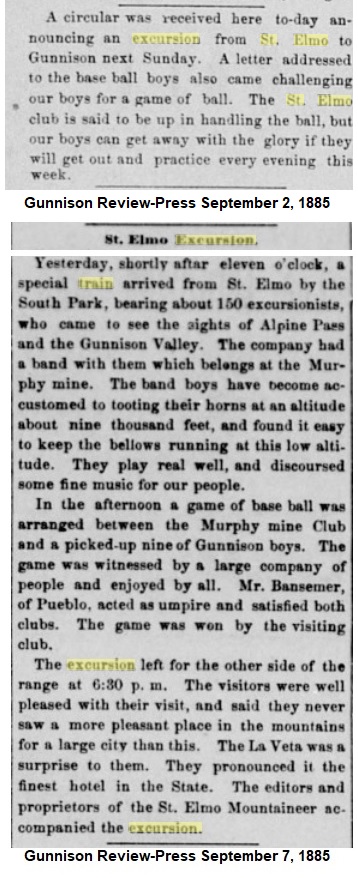 If the DSP&P RR had their own, then why would they borrow/rent one from the CC in 1885 for this St Elmo group excursion to Gunnison....by UP directive? .......unless the DSP&P Dolly Varden (flat)cars had all been previously stripped for Freight service once the Company realised that they had no repetitive destination(s) for excursionists(unlike the CC RR)....... or, were shipped off to the U&N the year before...by UP directive?  Whatever the reason, DSP&P must have lost a lot on deadheading that special train all the way to St Elmo, and back; maybe that's why we see no pictures of them West of Pine Grove, and after the t-o-c. Tundracamper sure has innocently opened a can of worms, and I thank him for that.  A Lime Car? Yes, for lack of documentation, other than Mal's, proximity to the Kiln at the then end of track(extended sometime between Sept 1895 & April '98) that should be a Limecar, far too enclosed to be of an open Observation car. One could query that alone on the "spotted" location, I would think? Dave's photo in question is the X-11133 at the DPL. But I did find this, what possibly may be an Excursion car, suitably enclosed with canvas as temporary shelter following the Morrison fire of late June, 1890. CRRM Colorado Rail Annual No.12 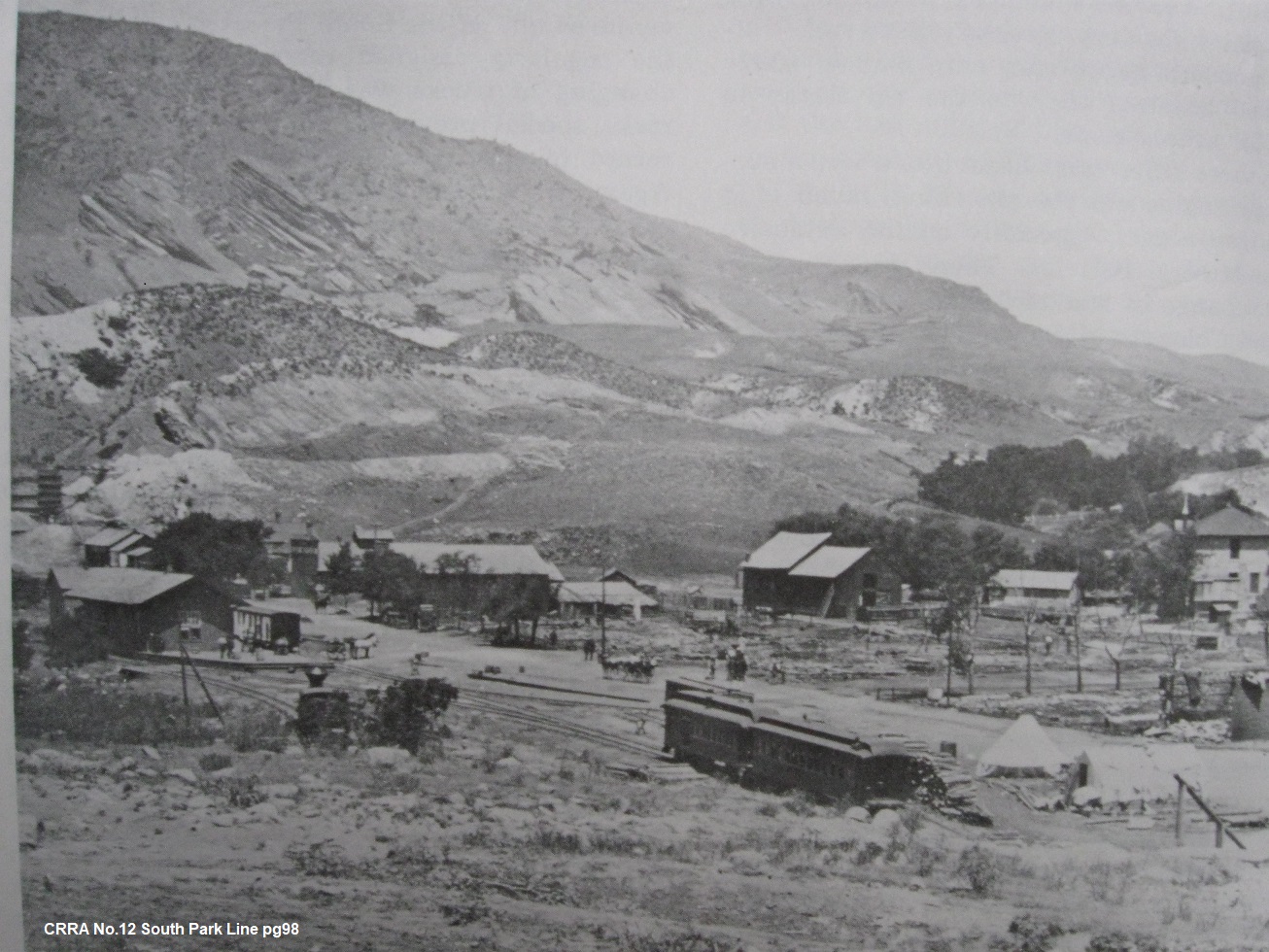 The only question is whose car is that? Worms everywhere, I tell you!
UpSideDownC
in New Zealand |
|
|
This post was updated on .
Chris, The lack of both photos and documentation bothers me--I wish we had all the information. Wait, then we'd lose the hunt that makes all this so interesting. 
My feeling, given the information we have for the mid-1870s South Park--a handful of articles, no photos and later reports showing no cars--is that the South Park may not have had dedicated cars but may have had removable superstructures allowing for the conversion of flatcars on the (rare?) occasions that the cars were needed. That is not to say they may have had cars that disappeared before 1884, also, and that nobody photographed them or the photos haven't surfaced if they did. I just think there's a case to be made that they didn't have dedicated cars. The CCRR connection to Denver in the later 1870s would simplify loaning cars to the DSP&P, but I don't know if that happened--did the South Park at that time need or seek them out given its own business levels? Photos would help! The CCRR is not once mentioned as loaning or leasing cars in the South Park's early push up Platte Canyon and on to Buena Vista in 1878-1880--but then there is scarcely any mention of the D&RG equipment that did make it up South Park rails then. I think the UP ownership is when everything changed, with cars moving fluidly between the CCRR and South Park. By 1884 that fluidity extended to South Park freight cars (400!) and engines (30!) being moved to Idaho as the Colorado business dropped precipitously. The South Park by that time may not have been able or didn't need its own excursion cars often, but it could borrow CCRR cars. So the CCRR excursion cars in 1885 St Elmo doesn't surprise me, both railroads were part of one system. I don't know if this is the true story but I do feel it is plausible given what we I know at this time. And on early South Park rosters, don't forget Ron Rudnick's. Mal's roster is based on the1885 Renumbering but does not discuss how he came up with the numbers. Ron does and also underscores the fact they are somewhat theoretical.
Dave Eggleston
Seattle, WA |
|
|
Denver Daily Times 3/22/78 Two of the South Park excursion cars are being remodeled to accommodate the track laying gang
|
|
|
This post was updated on .
Nice one, Ron! Food for thought. Here's another from a couple months later, this snippet of a May 5 1878 Rocky Mountain News article: 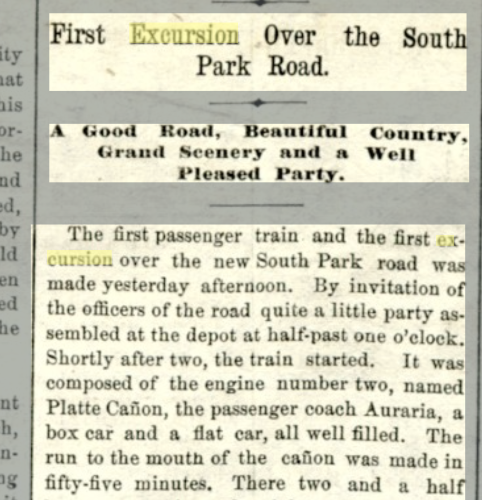 No excursion cars used. [Editing this to add another detail] I just found a June 27 1874 Rocky Mountain News article about the Dolly Varden cars. This could be read as something more substantial than a flatcar with removable superstructure but then it could be read as exactly that--the word "cheap" stands out. 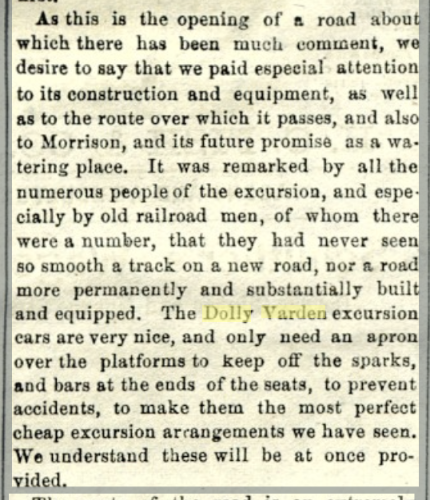
Dave Eggleston
Seattle, WA |
Re: DSP&P Passenger Car Research
|
|
In reply to this post by Tundracamper
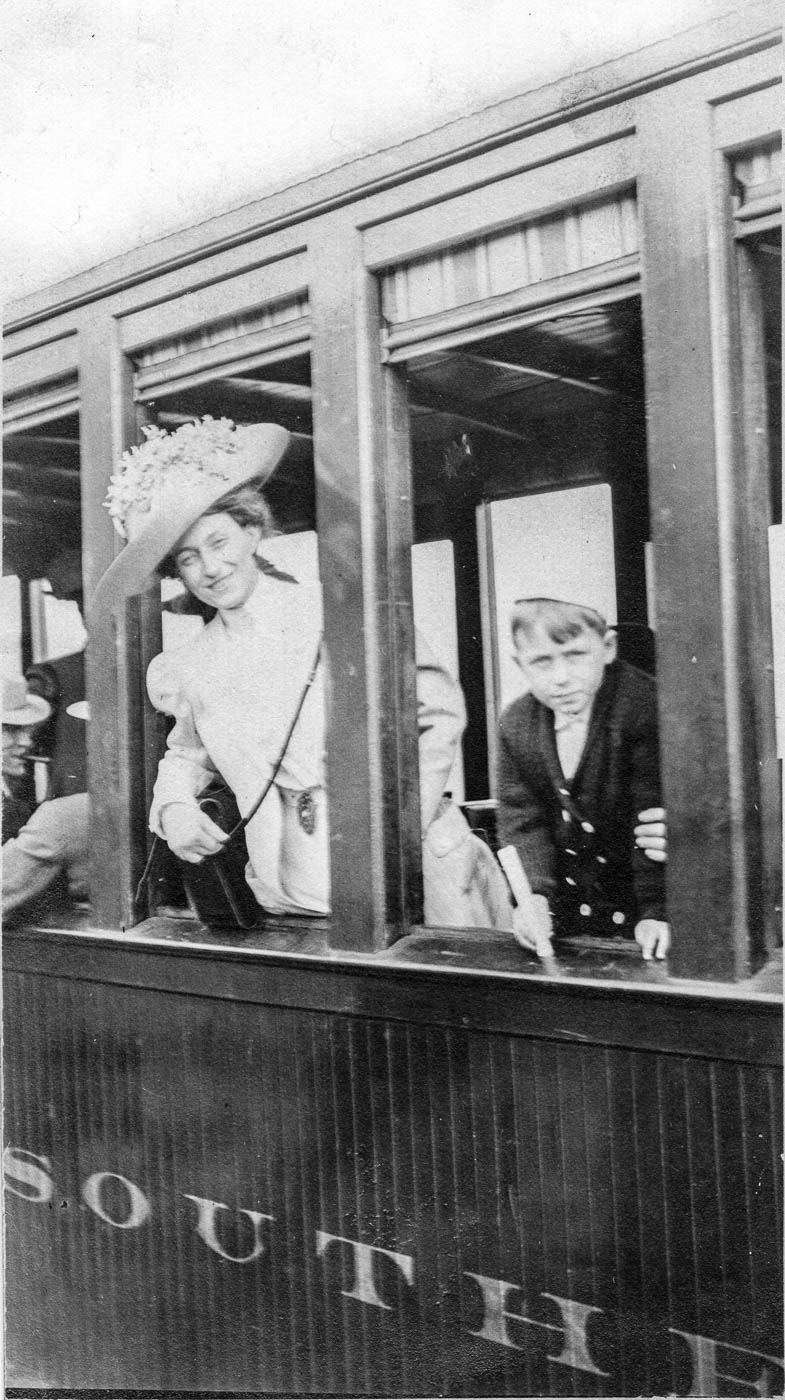
Here's another view. The photo was taken by Howard and features Lucy and Taylor. According to Howard, this is a "mountain climbing coach on top of Mt. McClelland (sic.)"
 Here's a close-up of the window shade and interior ceiling: 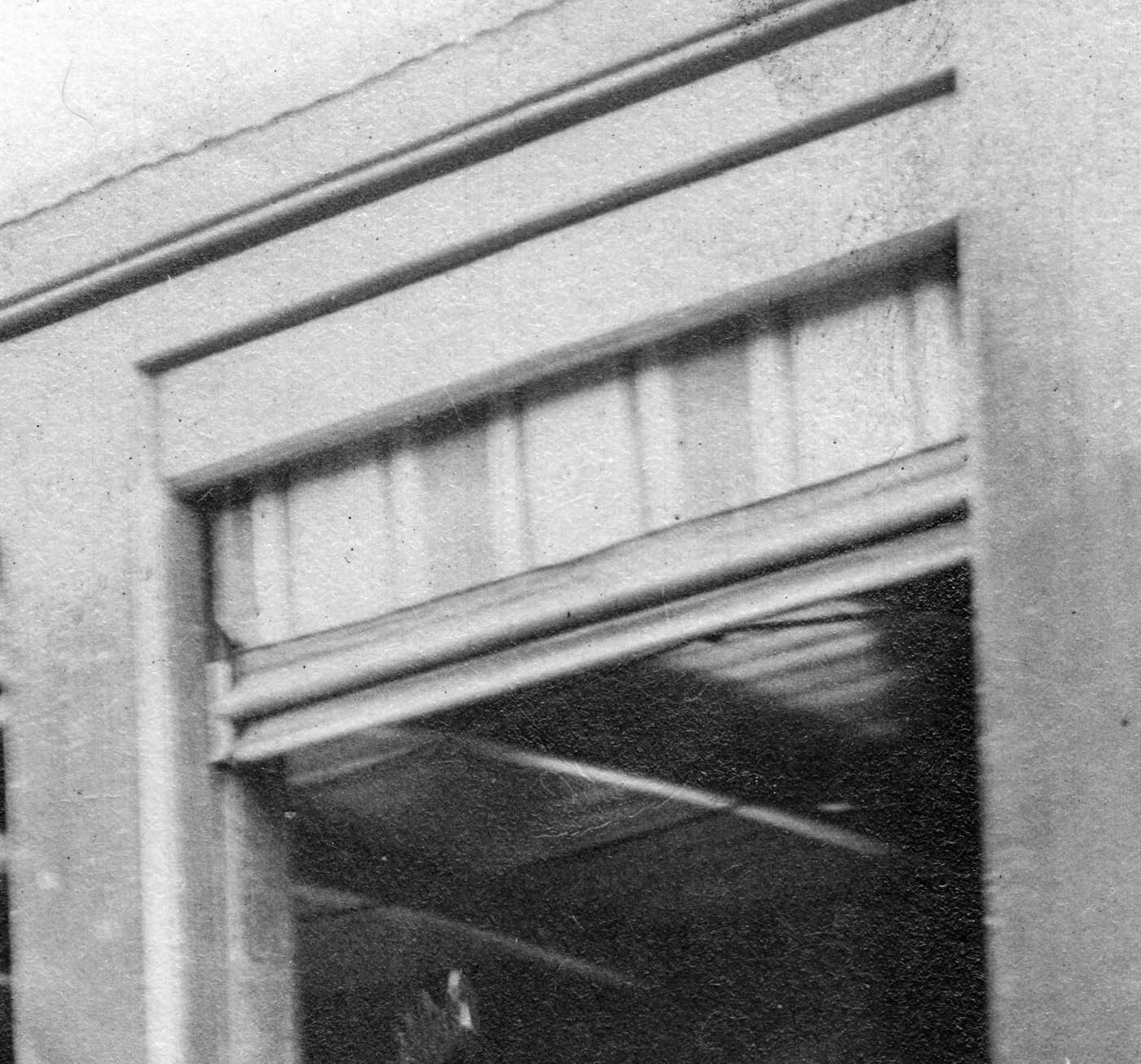
|
|
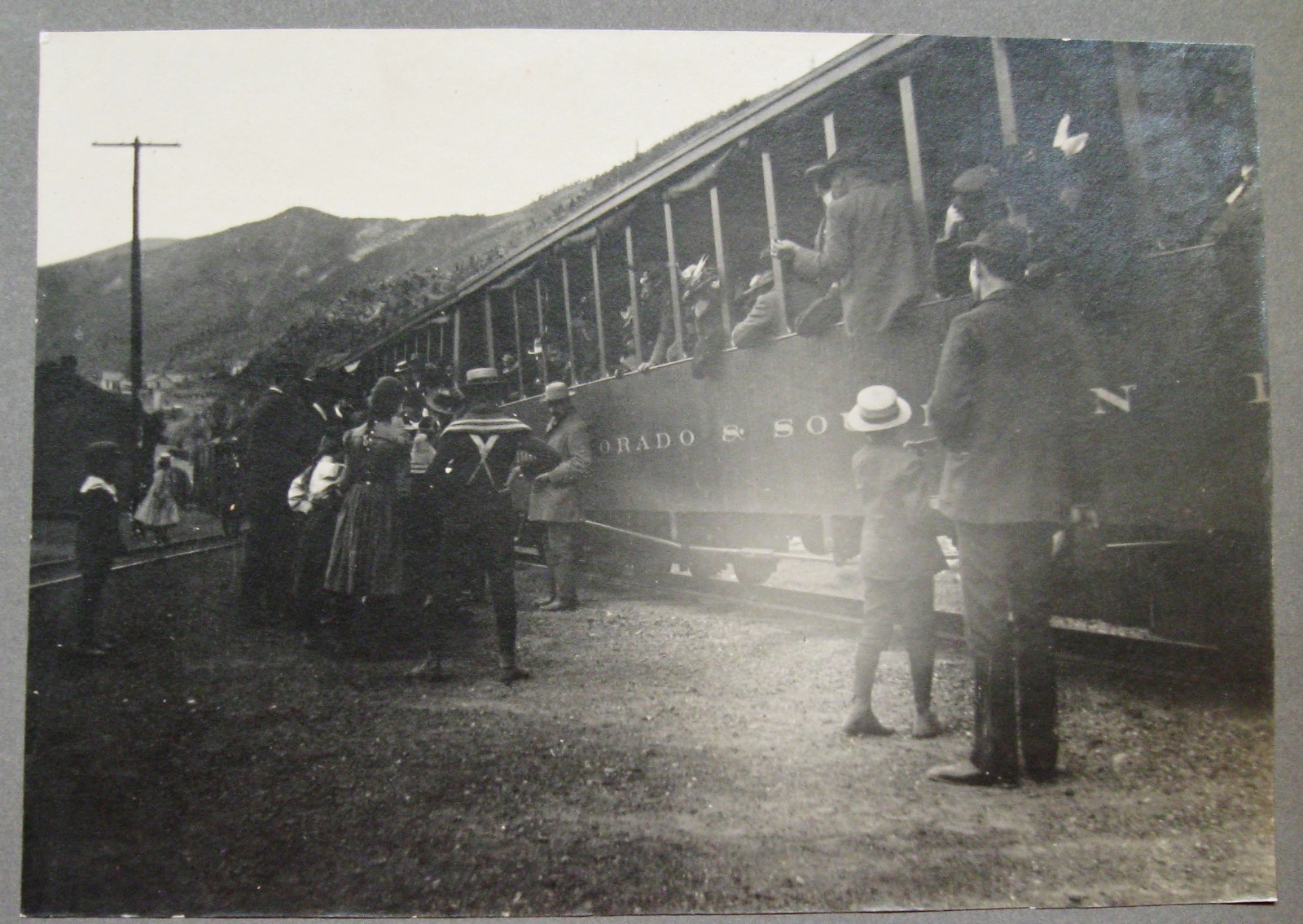
More interesting photos- Just reminds me that it has been a year and I have not even started on an excursion car.......
In any event I appreciate the interior roof photos- I had seen one source (but can not remember where) that said that at least some roofs were painted the lovely puke mustard yellow- but all these appear to be a dark (stained??) color. That sure looks better though.
Jim Curran
|
«
Return to C&Sng Discussion Forum
|
1 view|%1 views
| Free forum by Nabble | Edit this page |