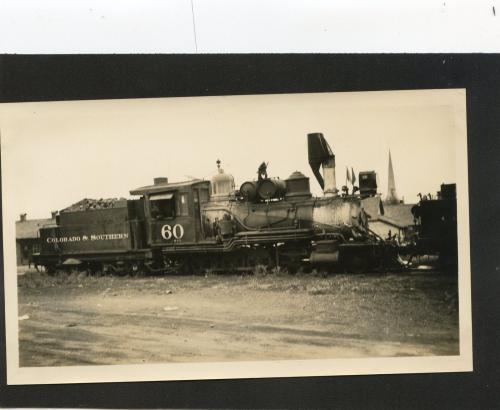
Got Milk? C&S number 60 in Leadville

Previous Topic Next Topic
 
classic Classic list List threaded Threaded
22 messages Options
12
Reply | Threaded
Open this post in threaded view
|

Got Milk? C&S number 60 in Leadville

Jim Courtney
This post was updated on .
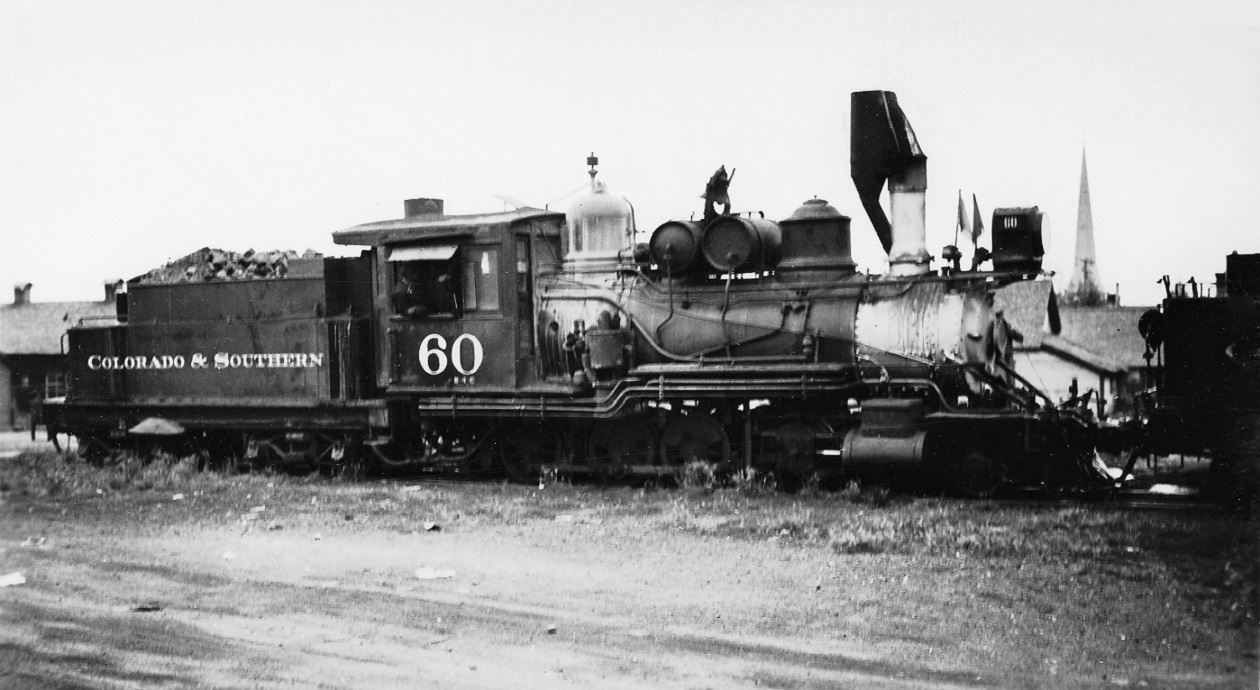
I was successful in purchasing this August, 1936 photo of C&S number 60 at Leadville:


Can anyone explain why someone poured a barrel of whitewash over the steam dome?  Or could it be a can of milk?  A very, very large Colorado bird flew overhead?

An interesting weathering touch, to say the least! Any ideas?


Jim in the Pacific NW, where the sun is finally shining!

(Edit:  Image replaced with 1200 dbi scan from actual print on 4/03/16)
Jim Courtney
Poulsbo, WA
Reply | Threaded
Open this post in threaded view
|

Re: Got Milk?

Keith Hayes
You know what the pot looks like after the pasta water boils over? Same idea, but with mineral water instead of starch. I am guessing something happened with the steam dome.
Keith Hayes
Leadville in Sn3
Reply | Threaded
Open this post in threaded view
|

Re: Got Milk?

Jim Courtney
Plausible explanation.

You realize that this represents a prototypical inconsistency with your version of Leadville, don't you?

As I see it, you need to pour a quarter of a bottle of thinned Floquil white over the steam dome of your Sn3 number 60.

Just say'in . . . .

Jim
Jim Courtney
Poulsbo, WA
Reply | Threaded
Open this post in threaded view
|

Re: Got Milk?

South Park
  I saw an exploded boiler once and the mangled flues all pouring out of
the no-longer-extant front end of the boiler shell looked a lot like spaghetti.

  I am pretty sure we've just incovered the South Park's little italian secret !
"Duty above all else except Honor"
Reply | Threaded
Open this post in threaded view
|

Re: Got Milk? C&S number 60 as the Leadville switcher

Jim Courtney
This post was updated on .
In reply to this post by Jim Courtney
Whatever the cause of the "white" steam dome of number 60, perhaps we should digress and discuss the Leadville switcher:

Due to the extensive standard gauge connections with the D&RG and Colorado Midland in Leadville, as well as the subsidiary Leadville Mineral Belt (a joint C&S / CM venture) which was dual gauged to allow cars of either gauge to be spotted at the mines, the C&S Leadville yard was dual gauged.

In the early years a couple of engines seem to be stationed at Leadville, for switching cars of both gauges, the engines having 3-way drawbar castings on both pilot and tender.  First decade photos show both Cooke and Rhode Island 2-8-0s working in that capacity.

Later, the Rhode Island B-4-Cs seemed to be the preferred power for the Leadville switcher.  Numbers 60 and  62 were the usual engines in the early years, with Cooke 39 also so photographed, and Cookes 43 and 48 cited. Number 62 continued to work in Leadville to the mid to late 'teens, before being assigned to the Buena Vista - Romley run.

According to the Colorado Rail Annual 12 (page 97), number 60 was the regular Leadville switcher from the early 1920s on.  This is the only photo I've seen of the 60 working as the switcher, c1923:
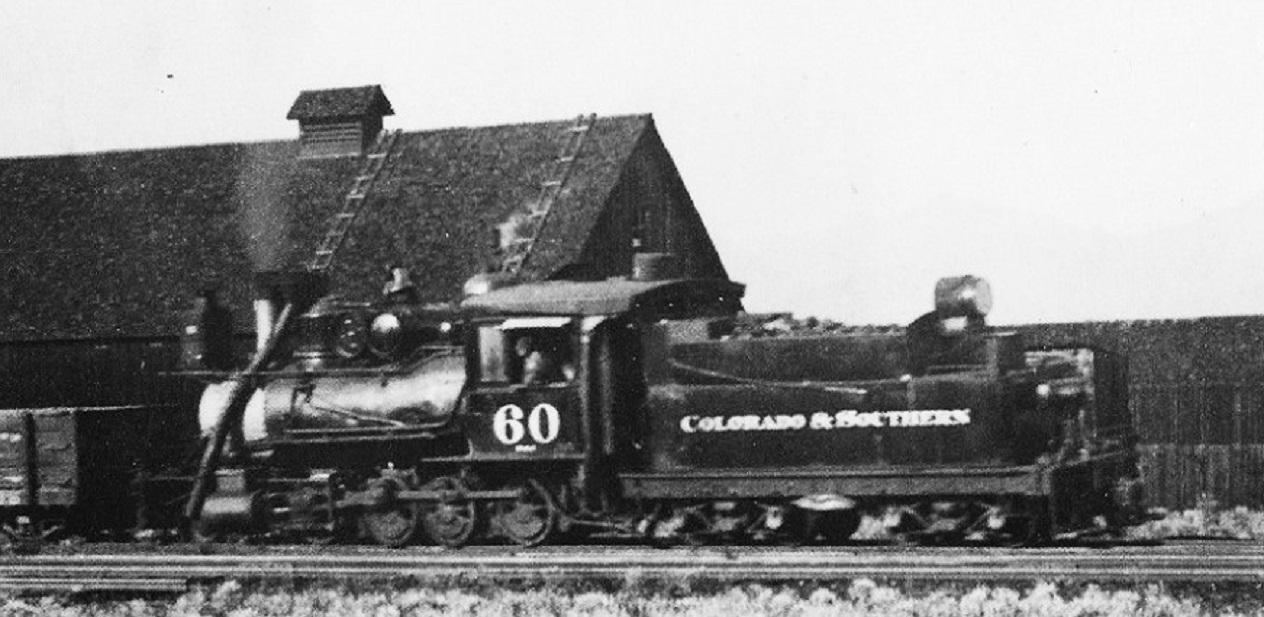

Derrell Poole Collection, in Narrow Gauge Pictorial Volume VIII

It is not clear whether the number 60 still has a 3-way coupler pocket on the pilot, but trails a tender with a funky back-up light and a 3-way draft gear. It already has the "cooking pot" on the cab roof (for a fire hose?).

According to CRA 12 the 60 worked as the regular switcher until as late as March, 1935. When the 60 had to travel to Denver for shopping, sister number 58 seems to be the preferred replacement. Evidently the 60 would be run to Denver as the passenger power on 71 or in a freight consist.  The tender with the dual gauge draft gear would then be swapped out with that on the 58, and the 58 then worked to Leadville to switch, until the 60 was returned to her usual assignment.

I had no idea that Leadville had an active switcher as late as 1935!  Perhaps that is why there are so few photos of the 60 between 1905 and 1936--she was sequestered away in Leadville.

So questions for you Leadville buffs:

When did C&S operations on the Leadville Mineral Belt actually cease?

When did the flanger 013 become a dual gauge coupler car?  How was it used, if the 60 had a three-way coupler on the tender?

When did the Leadville switching assignment end and road crews take on switching?

Inquiring minds want to know . . .


(BTW Keith, there is a reference in CRA 12 of the C&S occasionally borrowing one of the D&RG C-19s to fill in for a disabled switcher, as early as 1905).
Jim Courtney
Poulsbo, WA
Reply | Threaded
Open this post in threaded view
|

Got Foaming? C&S number 60 after Leadville Switcher

Mike Trent
Administrator
Interesting photo, Jim. I've heard stories about a foaming condition that sometimes would happen in a boiler, caused by impurities and operation. That's probably what happened here. For sure, that was the reason this picture was taken, probably by Brownie Anderson. If you are interested, you can read about foaming here: https://en.wikipedia.org/wiki/Priming_%28steam_locomotive%29

Foaming is caused by running the water level too high, which can result in serious problems if the engine starts working water instead of steam. Water cannot be compressed in the cylinders and will blow out the cylinders. What we see in the photo is probably the result of having to open the steam relief valve on the dome to prevent serious damage to man and beast. Foaming can cause false readings in the water glass. Fortunately, most of the enginemen on the C&S knew what this was all about and would have reacted immediately. This is why the old try cocks were never removed, to made sure the water level was within the safe range. Rick can probably relate more about this. It seems likely that a contributing factor here might have to do with the ancient wagon top boiler on #60, as it is quite different from the others and probably required it's own method to work the engine.

I have for years been under the impression that #60 was sent to Denver in 1935 for an overhaul as the time had run out on it's flues. An event also happened in 1935 that took two locomotives off the board for a time after the roundhouse fire in Como. Both #75 and #72 were out of service until the cabs and some other parts could be replaced. If #60 was in the shop at or near the time of the roundhouse fire, it seems highly likely that the decision was made in Denver to put #60 into helper service rather than to return to it's forlorn career as the Leadville switcher.

Keeping engines available for service in the mid thirties was increasingly challenging for the C&S as many of the aging fleet became more difficult to maintain. The problem became critical in January 1936 when both #75 (again) and #73 were wrecked on Boreas. This time #75 was more seriously damaged, and #73 could not even be recovered until the following Summer. It was during this time that the three C-19's were leased to help keep up with operations.

In the picture Jim posted, #60 has been removed from switching service, as the footboards have been removed from the tender and the backup light has been removed. Also, the snowplow has not been installed. Another use for #60 would have been as the emergency engine at Como for the passenger train. I've often wondered if that had been the reason for the plow. Keeping an emergency engine ready and under steam at Como was a requirement to maintain the mail contract in case of a mechanical failure, or if the road engine needed help to buck snow.    
Reply | Threaded
Open this post in threaded view
|

Re: Got Foaming? C&S number 60 after Leadville Switcher

Jim Courtney
This post was updated on .
Great information, Mike. Likely explains number 60's "milk moustache".

Do you have any idea when the Leadville switcher assignment with a designated locomotive and crew stationed there actually ceased? I'd always assumed that road crews did the Leadville switching after 1930 and was surprised to find a reference for a switcher as late as 1935.

One of the many ironies of modeling the C&S:  The number 60, due to it's survival and preservation, is the most popular C&S engine to be produced by the brass importers, with multiple runs in HO, S and O scale, and even a large scale version was produced.

Yet it was the least representative of all the Rhode Island engines, unique in it's class. And it spent most of it's life, not in helping freights up Kenosha or running up to Silver Plume, or powering the passenger train, but just switching cars every day in Leadville.

Jim
Jim Courtney
Poulsbo, WA
Reply | Threaded
Open this post in threaded view
|

Re: Got Foaming? C&S number 60 after Leadville Switcher

Mike Trent
Administrator
Jim, I believe you stated above that records show March 1935 as when #60 was no longer the designated switcher at Leadville. I would say that was when it ended, if there even was a "designated" Leadville Crew. In all probability, the switching crew was a rotation of Como based men, as the only engineman on the West End who lived in Leadville was Charley Williamson, who was killed on #75 in '36.

Forest Crossen had an interview in his "Western Yesterdays" series with Bon Oshier which I used as the introduction of my history of #74 for the RGS Technical Page http://riograndesouthern.com/RGSTechPages/rgstec7.htm :


I'll tell you I done something with the 74 there in Leadville one time.

We went down on the transfer (track) there. I think there was 21 loads in there for the C&S and Sanchez (conductor) says 'Let's shove these up on the Rio Grande, up on the hill as far as we can and get a run at it. Maybe we can pull 'em all out so we won't have to double them out.'

I says, 'OK. If we get stuck, all we have to do is cut 'em in two and make two trips.'

So I started out and I pulled those 21 loads over the transfer and that's something that'd never been done before. When I pulled out onto the mainline switch, if she'd a-slipped, why that would've been the end of it. She was right down to where she was just doin' her best. When I pulled out onto the mainline, why of course they started pickin' up and we pulled down into the yards.

There was two Rio Grande switch engines workin' down there, and they stopped switchin' and watched us, because I know they thought we'd never do it - because those Rio Grande engines couldn't do it. They was standard gauge, but they couldn't have shoved that many cars onto the C&S.

- John "Bon" Oshier, retired C&S Engineer (Crossen)


Bon Oshier was senior engineer among all the freight enginemen. Curley Culligan was Senior on the West End, and ran Passenger.
Reply | Threaded
Open this post in threaded view
|

Re: Got Foaming? C&S number 60 after Leadville Switcher

Jim Courtney
Great story, Mike.

Stuff like this makes the C&S narrow gauge come to life.  With my brief (four summers) career as a brakeman during college days, I know just enough to vividly imagine how the crew handled those 21 cars.

Thanks again for all the things that you contribute here.  The "oral" histories that you've accumulated add much to the photographs and documents that remain.

And you build great models, too!

Jim
Jim Courtney
Poulsbo, WA
Reply | Threaded
Open this post in threaded view
|

Re: Got Foaming? C&S number 60 after Leadville Switcher

Jeff Young
> Thanks again for all the things that you contribute here.

Indeed.  I greatly enjoyed both those posts.

(And thanks to Jim for starting this off….)

Cheers,
Jeff.
Reply | Threaded
Open this post in threaded view
|

Re: Got Foaming? C&S number 60 after Leadville Switcher

Mike Trent
Administrator
This post was updated on .
Thanks, guys.

Note: This post has been edited to correct an error regarding my identification of #75 as actually having been #69 per information posted below by Tom Klinger from Brownie Anderson's time book. The other two engines, #74 and #65, have been added.

After actually going back and looking at the listing on ebay, (did you get it, Jim?) the inscription on the back dates the photo as August 1936, which is when #73 was recovered from the wreck site on Boreas. So #60 was definitely pressed into helper service.

With what we can see in the photo, there are a number of probable conclusions that we can draw.

1) #60 and #69 were helpers, along with #65 and #74 on a Westbound Extra Freight between Como and Leadville on August 19th, 1936. That appears to be #69's tender coupled to the front of #60 in the photo, corroborated from Brownie Anderson's time book.

2) After taking coal at Dickey, #60, probably cut in ahead of the caboose as it was the smallest engine, started working water climbing the 4% grade up Fremont Pass. The engineer immediately closed the throttle, opened the steam relief valve, pulled the air, and the fireman dumped the fire, to avoid scorching the crown sheet. Another possible scenario is that as soon as the engineer closed the throttle, the pops opened, releasing water instead of steam as the fire was stoked on the grade. The engine could possibly have been worked to Leadville, but if there was any concern at all about damage to the cylinders or throttle, or even the condition of the water in the boiler, they would have carried it dead.

3) #69, #65 and the road engine, probably #74, worked the train up to the top of the pass, possibly having to double the hill. Then #69 returned to pull #60 up the hill and into Leadville. If still present, the caboose may still have been coupled behind the #60. Upon arrival in the fading light, this photo was taken, before #60 was spotted where the boiler could be flushed and an inspection made. Note the almost full coal load in the tender, and the engineer is still sitting glumly in the cab.

4) If there is another Extra the following day, it could be a long trip back to Como, as #60 will not be answering the bell for that trip. If not, the enginemen will climb into a car and make the trip back to Como for a late dinner and a good night's rest.

Just another day of mountain railroading on the High Line.

Reply | Threaded
Open this post in threaded view
|

Re: Got Foaming? C&S number 60 after Leadville Switcher

Jim Courtney
This post was updated on .
After actually going back and looking at the listing on ebay, (did you get it, Jim?) the inscription on the back dates the photo as August 1936, which is when #73 was recovered from the wreck site on Boreas.

Yes, I did.  The print should arrive in the mail today or tomorrow.  I'll make a high-res scan and re-post that at the top of the thread.

But the plot thickens!  On the same day, I bought a print of number 75 spotted at the water stand pipe in Leadville (a good week for C&S photos on eBay). Though I thought the number 75 photo was taken the same day as that of number 60, no firm inscription for date was noted in the listing.

Now I'm not so sure. I'm bidding on a second print of 75, running light on Boreas, and the inscription on the back is also dated August, 1936, in the same handwriting as the inscription on the back of the number 60 photo above. http://www.ebay.com/itm/111950562276?_trksid=p2055359.m1431.l2649&ssPageName=STRK%3AMEBIDX%3AIT&autorefresh=true  So it may be another Brownie Anderson photo. The print date on the bottom of the photo of 75 running light is 1937.

To make a long story short, there are differences in the details of 75 between the Leadville and Boreas photos, which may suggest pre and post January 1936 wreck photos.

Since Mike is the go-to guy for anything about number 75, I'll likely need his help in dating the Leadville photo. I'm working my shift in the hospital today, will try to post any photos that arrive in the next couple of days.

Mike, I thoroughly enjoyed your operational analysis of how number 60 acquired her white dome!

Jim

Jim Courtney
Poulsbo, WA
Reply | Threaded
Open this post in threaded view
|

Re: Got Foaming? C&S number 60 after Leadville Switcher

Mike Trent
Administrator
Thanks Jim, glad you got the print. This one is nice too, it shows that unpainted Brooks numberplate with the brass numbers as well as I've ever seen it. I wonder if that fireman is Doug Schnarbush. Brownie Anderson was well known for carrying a Kodak box camera with him, he knew these would all be very rare photos. It is indeed very rare to see these working pictures. Pictures such as these were taken during weekdays in remote areas which would have been very difficult to reach by a railfan photographer.

I remember my Dad sitting hunched over his pictures with a magnifying glass and a pencil to write details on the backs of each photo. He learned much of what he knew and how to organize his collection from Dick Kindig, and Kindig probably also had encouraged Anderson to try to keep track of details in this way, along with Otto Perry, who were well known to these men.

I wonder how many crooked shots like that of #75 were thrown away or never printed. Sure is nice that this one survived. It's almost like standing there in the weeds looking at the engine. Did you notice the single flag? #60 has two.
Reply | Threaded
Open this post in threaded view
|

Re: Got Foaming? C&S number 60 after Leadville Switcher

Jim Courtney
Hope I get the photo of 75 running light, too. Or someone on this board does!

I don't collect photos per se, this is a new endeavor for me. But if I see a C&S print that I don't recognize as having been published, I try to acquire it so I can scan it and post it here. It's the content that's important to me, not the physical print itself.

As I've said before, I hope that Roper's Dog House can be a repository for any C&S narrow gauge loose ends that turn up, before they disappear.  I would hope that others will do the same.

Anyway, you brought up the single marker flag:  Do you think it's just a very dirty, white "extra" flag, or is it perhaps a green flag on a helper running light ahead of its train, to designate a "second section" following? I know the inscription says the 75 is "pushing" the extra train, but it isn't coupled in, and appears to me to be running light, downgrade.

Jim

Jim Courtney
Poulsbo, WA
Reply | Threaded
Open this post in threaded view
|

Re: Got Foaming? C&S number 60 after Leadville Switcher

Southpark
In reply to this post by Mike Trent
In response to Mike's photo of #60 at Leadville A.A.Brownie  Anderson's time book shows in 1936, Aug 19, Como-Leadville #69,74,65,60 then on Aug 20 the same order return Leadville-Como.
Anderson shows #60 on several trains in Sept, Oct, and Nov.  Keep in mind these are only trips Anderson was on.
Tom Klinger
Reply | Threaded
Open this post in threaded view
|

Correction

Mike Trent
Administrator
Interesting, Tom. Is his timebook published?

I went back and blew up that photo, and compared what I saw to photos in the Volume VI Pictorial, and jumped the gun on my identification of #75's tender.

Yes, I believe that is #69's tender instead, given the high position of the air tank, the probability of a narrower tank by studying the lamp brackets, and the location of the lettering. I'll go back and edit/correct the error in my above post.

Thanks!
Reply | Threaded
Open this post in threaded view
|

Re: Got Foaming? C&S number 60 after Leadville Switcher

Mike Trent
Administrator
In reply to this post by Southpark
Tom, I looked at the calendar for 1936 and found that the 19th of August was a Wednesday, which means that the Westbound freight was running on a day which was normally running East and vice-versa on Thursday the 20th. There was plenty of flexibility as the freight trains were all classed as "Extra", much to the chagrin of the crewmen. The two day freight cycle on the West End originated out of Leadville, so Anderson must have bumped somebody to get a Como-Leadville-Como turn that week. Doug Schnarbush told me that Anderson was usually among the guys who commuted to Leadville for the turns and usually drove.
Reply | Threaded
Open this post in threaded view
|

Re: Got Foaming? C&S number 60 after Leadville Switcher

Keith Hayes
In reply to this post by Mike Trent
Mike,  an interesting scenario, but why would they wye/turn the Loco before taking the photo? Good spotting the coal liad, however,  the Loco could have topped off at the roundhouse and backed up to take water and pose for the photo.
Keith Hayes
Leadville in Sn3
Reply | Threaded
Open this post in threaded view
|

Re: Got Foaming? C&S number 60 after Leadville Switcher

Jim Courtney
This post was updated on .
Maybe the event that gave number 60 the "milk moustache" happened inbound on Tuesday, the day before.

The 60 may be spotted with the other power near the water stand pipe, fully coaled, prior to returning east bound to Denver on a Wednesday.  Cleaning up the "boiled over pasta" mess on the steam dome may have had to wait until number 60 was back in Denver, at the roundhouse.

But that doesn't reconcile the date on the photo, with the date in the Anderson time book.

So, when a multi-engine train arrived in Leadville in the late afternoon, was it common practice for the road engine crews to turn, coal and water their engines and spot them behind the depot for the next days departure?  (There are quite a few photos showing a string of locomotives spotted there, usually pointed eastbound with full tenders--but why do all this stuff at the end of a work day, instead of the beginning of the next work day?)

Was there a hostler still on duty at Leadville in 1936 that might have done these functions for the train crews?

If these are fully serviced locomotives, spotted behind the depot for the next days departure, why were they left outside overnight?  Why weren't they bunked down in that roundhouse that Keith is building?


Speculation about the past is so much fun! You often come up with more questions than answers.
Jim Courtney
Poulsbo, WA
Reply | Threaded
Open this post in threaded view
|

Re: Got Foaming? C&S number 60 after Leadville Switcher

Mike Trent
Administrator
I can't really defend either of my scenarios, not having been there, so anyone else's ideas are as valid as mine. True, we don't really know which day this photo was taken, and could have been, according to Anderson's time book, the next day, Thursday the 20th. But #60 looks dead to me, which makes me think it was taken the day it happened. Ordinarily, since there was no switching Westbound, the train would arrive in Leadville in the middle of the afternoon. According to Anderson's time book, the same engines were used the following day, so they'd have had to have gotten her hot and ready for service with the others right there, assuming all this is true.

There was definitely a hostler on duty at Leadville, possibly even two of them, whose duties would have included preparing the engines for the next run, and tending the engines overnight. There would have been anywhere from one to five engines overnight, depending on the schedule.

12