Fouling Posts, Clearance Posts, or Limit Posts on DSP

Previous Topic Next Topic
 
classic Classic list List threaded Threaded
8 messages Options
Reply | Threaded
Open this post in threaded view
|

Fouling Posts, Clearance Posts, or Limit Posts on DSP

Tundracamper
Were such posts, used to denote the farthest location a railroad car could be parked on a siding before possibly interfering with the main line, ever used on the DSP&P?  AI seems to think they may have been used post-1885 after the takeover by the UP or may have been simple sticks or short posts prior. Still, just curious if anyone has noticed any such marker in any photos. I did see the thread here related to the harp stand marking a derail. But can’t seem to locate anything about fouling posts. TIA
Reply | Threaded
Open this post in threaded view
|

Re: Fouling Posts, Clearance Posts, or Limit Posts on DSP

Mike Trent
Administrator
The Harp Switchstand used as a derail was once, in earlier days, used as part of a crossover between the mainline and siding. It was located on what I would refer to as the Leadville siding near the water tank. it had no target in later years, probably intentionally,

I'm not at all aware of the marking posts you refer to.
Reply | Threaded
Open this post in threaded view
|

Re: Fouling Posts, Clearance Posts, or Limit Posts on DSP

Dave Eggleston
This post was updated on .
In reply to this post by Tundracamper
I wouldn't trust AI to be an expert on anything South Park.

I suspect fouling points weren't marked by poles or painted rails on the pre-1885 South Park, if at all.  

There exists an 1885 UP standards book showing no fouling point posts nor signs but it does include a "clearance plate" for affixing to the top of a tie.
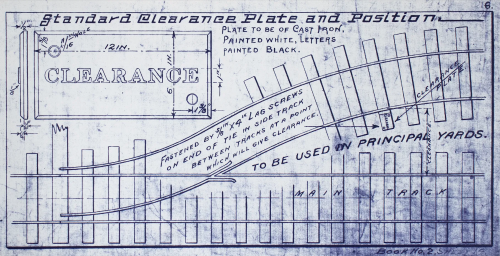


"To be used in principal yards."

The existence of the above clearance plate in a UP Standards book should not be taken to mean they were used on the Colorado narrow gauges under UP control. You might see these in Denver, possibly Golden or Boulder. The South Park by 1885 wasn't a money-maker for the UP. Maintenance was kept to a minimum. Expenditures on new equipment was pretty much limited to flangers and the rotary plow for the rest of the decade and into the mid-1890s. A lot of equipment had been moved out of Colorado to the U&N and OR&L by 1885, two lines which did make money.

People need to look closely at photos to see if they can find any examples of these plates. I'll say my guess is not, just to improve the odds of finding one.
Dave Eggleston
Seattle, WA
Reply | Threaded
Open this post in threaded view
|

Re: Fouling Posts, Clearance Posts, or Limit Posts on DSP

Tundracamper
Dave Eggleston wrote
I wouldn't trust AI to be an expert on anything South Park.

I believe fouling points weren't marked by poles or painted rails on the pre-1885 South Park.

There exists an 1885 UP standards book showing no fouling point posts nor signs but it does include a "clearance plate" for affixing to the top of a tie.


The existence of the above clearance plate in a UP Standards book should not be taken to mean they were used on the Colorado narrow gauges under UP control. The South Park by 1885 wasn't a money-maker for the UP. Maintenance was kept to a minimum. A lot of equipment had been moved out of Colorado to the U&N and OR&L, which did make money. People need to look closely at photos to see if they can find any examples of these plates. I'll say my guess is not, just to improve the odds of finding one.
Thanks for that info. Even though odds seem to be in favor of them NOT using anything, I do still find the use of a plate marked CLEARANCE intriguing. Learned something today. Thx!!
Reply | Threaded
Open this post in threaded view
|

Re: Fouling Posts, Clearance Posts, or Limit Posts on DSP

Mike Trent
Administrator
Me too. Thanks.
Reply | Threaded
Open this post in threaded view
|

Re: Fouling Posts, Clearance Posts, or Limit Posts on DSP

Chris Walker
A quick look through my images, directly related to the "Park", taken back in the earliest years at Buffalo, Nathrop and Chalk Creek, show zippety.

As for yard tracks...I'm taken back almost 50 years to Loco Trainee school, and on the 2nd day we were shown how to step on 'n off moving Loco's, and stabling Locos.  NZR practice, both in Loco running and Traffic was to stand on the tangent rail and with arm out-stretched gauge the clearance.  
Of course that only applied to 3ft 6in as I was to later find out in the USA.  I'm sure there was an equivalent distance rule of thumb "up top", as ground cover in the form of fines would obscure any of those cast clearance markers(all our Yard/Depot tracks were covered to the rail tops).
 
And then you guys have Snow!
Argyle
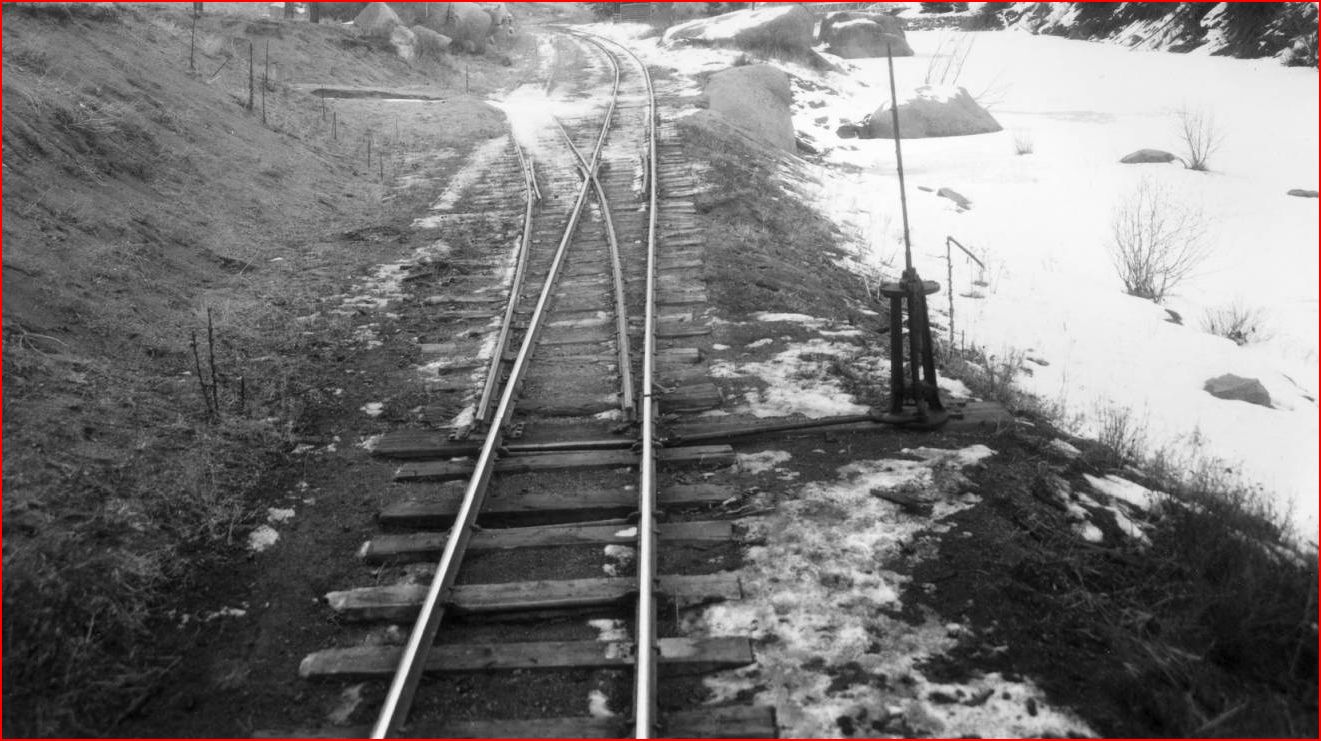
DPL X-6679
 

Note; it's quite obvious just where the "fouling point" is/was.
UpSideDownC
in New Zealand
Reply | Threaded
Open this post in threaded view
|

Re: Fouling Posts, Clearance Posts, or Limit Posts on DSP

Paul R.
Take note of the switchstand.!!
Reply | Threaded
Open this post in threaded view
|

Re: Fouling Posts, Clearance Posts, or Limit Posts on DSP

Chris Walker
Paul R. wrote
Take note of the switchstand.!!
* C&S era photo used to illustrate Spur curve and proximity to Mainline tangent; with light snow covering.

Argyle shown; Spur out of use; Main rail drifted and spiked; target removed.
UpSideDownC
in New Zealand