|
Questions. I have questions.
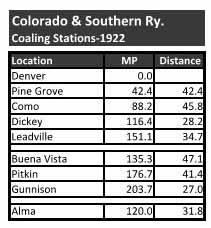
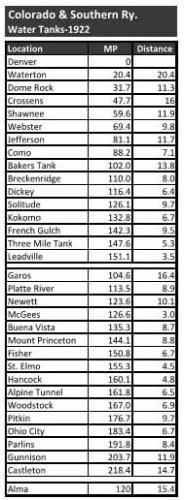
First, it is peculiar that on the South Park coaling and water facilities only coincided at Denver, Como, Dickey, Leadville, (Hancock), Pitkin and Gunnison. No wonder this was an expensive railroad to operate: trains could rarely stop for fuel and water at the same place! Okay, maybe it was only at Pine Grove. Here is a compilation for coaling locations from the 1922 Timetable (with some help from other sources). ![]() I did not include the coaling platforms that were likely at Boreas, Climax, Hancock and Alpine Tunnel, as these were not listed (though if popular demand asks for it, I will include them and any other corrections). Note that coal docks are about 40 miles apart. What got me thinking about this is how many carloads of coal a locomotive requires. John was kind enough to log all of the D&RGW tender capacities in his post on C&S #70, but I cannot find that he compiled C&S tender capacities anywhere. What's up with that John? Anyway, knowing the tender capacity (heaped) would tell us how many carloads need to be delivered at Dickey or Pine Grove. One can imagine that those four-locomotive freights pounding up Platte Canon required an extra locomotive just to haul the coal to refuel the train! In contrast, here is the data I could find on watering holes: ![]() I am sure there are some missing tanks here. Some moved, and a few were abandoned. I find it hard to believe there is not a tank between Como and Bakers Tank (the latter is not listed on the 1922 timetable, nor is French Gulch or Three Mile). On the other hand Solitude and Kokomo seem redundant. Distance between water tanks averages just under 10 miles, or three water stops for each coal stop. Also of note is the number of water columns and odd spouts (Breck and Mount Princeton) in contrast to the more iconic wooden water tanks. In fact, considering the examples at Dome Rock and Garos, one is apt to conclude there is no such thing as at typical South Park water tank. So there you have it. Talk amongst yourselves.
Keith Hayes
Leadville in Sn3 |
|
Riverview Tank (aka Buffalo) at MP 38.8
Riceville MP 60.00 Hoosier MP 73.83 (mentions bad, limited water) ========== Halfway MP 93.95 Selkirk MP 96.09 (1912 listing 1mile below spur) Boreas MP 98.84 Wheeler MP 126.16 ========== Hortense MP 142.09 Midway Tank at MP 168.66 Platte River tank was at MP 112.78 Also Schwanders had a Coaling Platform later a 8 pocket Chute. " " Boreas had a coal bin16'x45' burned 1909 " " Breckenridge coal bin12'x85' All those came from Mac Poor DSP&P Mem. Ed. p.s. How do you get water at Pine Grove?
UpSideDownC
in New Zealand |
|
This post was updated on .
In reply to this post by Keith Hayes
According to Poor in his Denver, South Park . . ., Grant, MP 66.15, at one time had a 47,500 gallon tank that was removed "prior to 1912".
Since Grant was only 3 miles below Webster, the tank spacing here is pretty close. I suspect westbound trains may have added additional helpers here for Kenosha, as light engines assigned as helpers could come over from Como and turn on the wye (none at Webster), take water and also coal if needed (Poor list a 13 x 363 foot coal bin as well). Or, when Kenosha was blockaded with snow, this might have been as far west as trains got during some winter months. From the one photo of Grant that that I've ever seen that includes the tank, an 1880 photo on page 183 of Mineral Belt I, the tank and coal bin appear to be at the far east end of the siding that was on the south side of the main. Derrell published an article in the 2006 CNGQ, stating that the tank and original coaling bin were removed between 1893 and 1894. Curious, it seems that the tank would have been convenient in later years, as the "Fish Trains" usually tied up on Sunday night at Grant, turned and returned to Denver the following morning.
Jim Courtney
Poulsbo, WA |
|
In one of the early photos of Webster on the DPL,there appears to be a wye.
|
|
Check out DPL photo X-14031.
|
|
In reply to this post by Keith Hayes
Here you go, Keith, a perfectly efficient water and coal station on the South Park -- Grant, early 1880s:
![]() Photo credited to Alex Martin, Richard Ronzio Collection, Mineral Belt I, D.S. Digerness, Sundance Pub. Ltd, 1977, page 183. The tank and coal bin are in the distance at the east end of the little yard. The wye was located just behind the little pond over the depot (center, 3 chimneys) and isn't clearly visible, perhaps it hasn't been installed yet. In a typical Union Pacific management decision, the facilities here were deemed too efficient and were removed in 1893 or 1894, according to Derrell's article in the 2006 CNGQ. Derrell also speculated that an engine house might also have been located here, but I can't make one out.
Jim Courtney
Poulsbo, WA |
|
From memory - according to a contemporary news article the engine house burned down in late 1879 with loco 24 in it. In those days it was a division station.
|
|
In reply to this post by Robert McFarland
|
|
Thanks for posting these 2 photos, Chris. Sorry though, I can't convince myself that there is a wye in the first photo.
Jim Courtney
Poulsbo, WA |
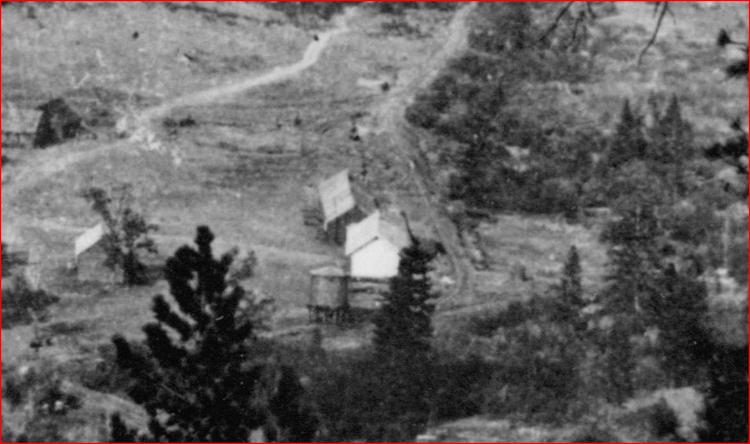
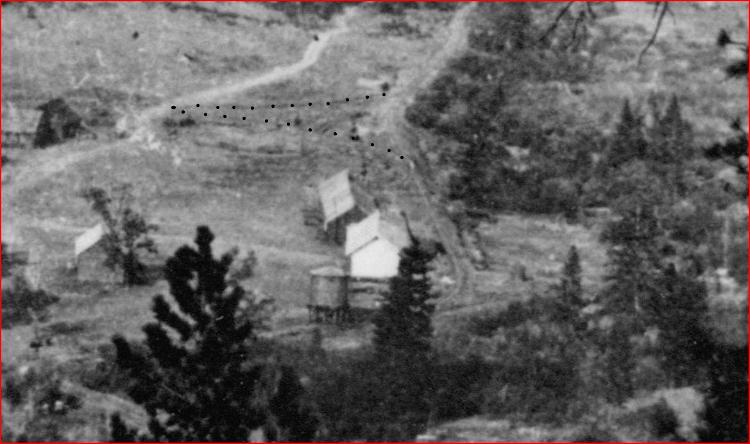
![]() Does that help? Dare I point out the Tank has been relocated? {:))
UpSideDownC
in New Zealand |
|
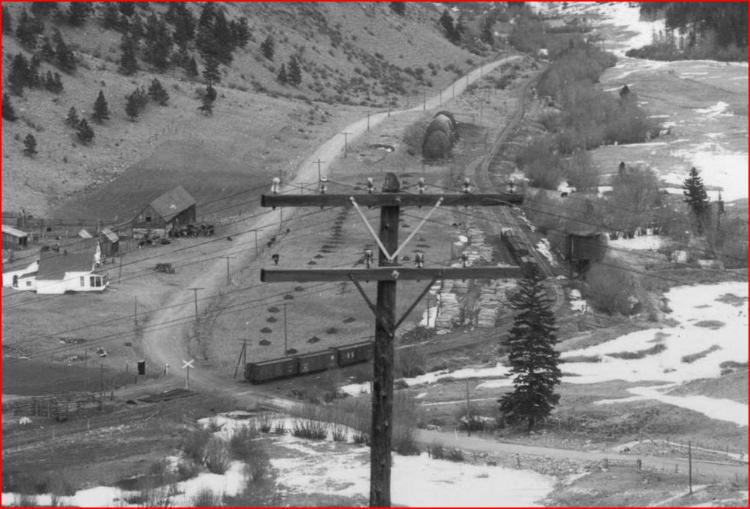
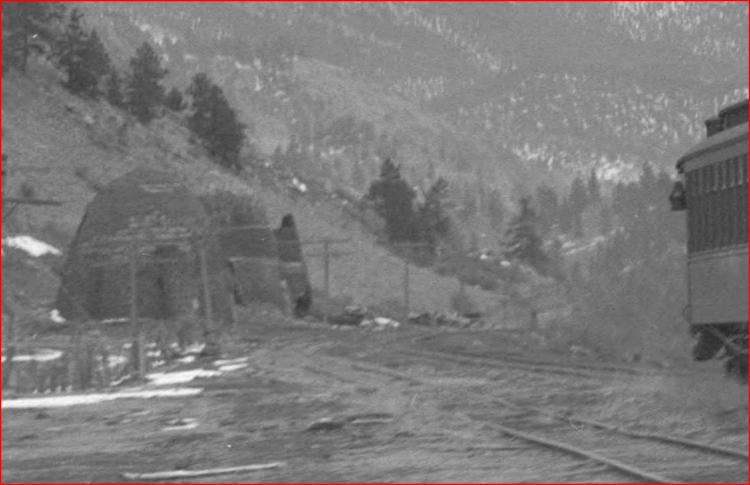
I will display my ignorance and blame it on all of my reference materials being in storage. Are the three "humps" in the second photo of the first batch charcoal kilns? Any idea what the little black piles arrayed around the plot partially hidden by power pole are in the same photo? Almost look like mulch around trees making a grove. Bill Uffelman Ocean View DE On Wednesday, February 25, 2015 4:45 PM, Chris Walker [via C&Sn3 Discussion Forum] <[hidden email]> wrote: ![]() Does that help?
UpSideDownC
in New Zealand If you reply to this email, your message will be added to the discussion below:
http://c-sn3-discussion-forum.41377.n7.nabble.com/Coal-and-Water-on-the-South-Park-tp1381p1466.html
To start a new topic under C&Sn3 Discussion Forum, email [hidden email] To unsubscribe from C&Sn3 Discussion Forum, click here. NAML |
![]() http://digital.denverlibrary.org/cdm/fullbrowser/collection/p15330coll22/id/42523/rv/singleitem/rec/25
UpSideDownC
in New Zealand |
|
So I have not lost my photo analysis skills! Thanks. Bill Uffelman On Wednesday, February 25, 2015 5:12 PM, Chris Walker [via C&Sn3 Discussion Forum] <[hidden email]> wrote: ![]() http://digital.denverlibrary.org/cdm/fullbrowser/collection/p15330coll22/id/42523/rv/singleitem/rec/25
UpSideDownC
in New Zealand If you reply to this email, your message will be added to the discussion below:
http://c-sn3-discussion-forum.41377.n7.nabble.com/Coal-and-Water-on-the-South-Park-tp1381p1468.html
To start a new topic under C&Sn3 Discussion Forum, email [hidden email] To unsubscribe from C&Sn3 Discussion Forum, click here. NAML |
|
In reply to this post by Chris Walker
Okay, I'm starting to buy it!
Jim Courtney
Poulsbo, WA |
|
An update to this thread with the following.
A photo by R. Kindig printed inside the front cover of Mal Ferrell's C&Sng and on pg193 of Mineral Belt V-1 shows the Footings of a former Water Tank at the approaches to Kenosha Pass on the East side of the Wye. In Klinger's C&S Highline Memories on pg229 there is a picture of the 3-Mile Tank near Leadville: This shows clearly yet another W.T. with Cast Iron support columns w/rod braces of the same type as the 2nd Idaho Springs(4th & 5th Ave) Tank.
UpSideDownC
in New Zealand |
|
In reply to this post by Keith Hayes
I see that I have been thinking about coal and locomotives for a solid decade. At the heart of my question is, "how often do you have to run a string of coals along the line to replenish the coal used?"
I found in the locomotive folios that the 2-6-0s and some of the 2-8-0s had 5 ton coal capacity. In the 30s, a 4-engine train would depart Denver, and each loco is rated for about 4 cars up the 4%, which is the ruling grade of each segment of railroad Denver-Pine Grove-Como-Dickey-Leadville. Coals are rated at 50,000 pounds capacity, or 25 tons, so one coal can fill (5) tenders full. For my model, I assumed each of the four locos would need 4 tons at Pine Grove (long run, but maybe flatter?); 4.5 tons at Como (up the 4% to Kenosha, and a longer stretch down into the Park); 4 tons at Dickey (short run, but a steep climb over Boreas); and 4 tons at Leadville (agan, short run, but a steep climb up Fremont). Stations have coal both coming and going, except at Leadville, where you fill the tender once for the return trip. Based on this use a westbound consumes 50 tons/ 2.0 carloads of coal and the return trip requires 66 tons, or 2.64 cars. I suppose one could argue that there would be less coal consumed eastbound between Pine Grove and Denver as the trip is all downhill, but let's set that aside for the moment. Based on this math, you need the 4th loco just to haul the coal to supply the train to move it over the line. After three trips, you would consume 14 carloads of coal. For every three trips you would need 3-4 carloads of coal at Pine Grove, 4-5 carloads at Como, 3-5 carloads at Dickey and 2 carloads at Leadville. This might help explain why coal was stockpiled at Dickey. What this tells me is that if you model the line east of Dickey, every 4th train is a trainload of coal. For the train from Dickey to Leadville, I need to have 2 carloads of coal for engine service every 4th train. Mike, did Doug every talk about how the coal trestles were switched? There is a great photo of a brakie standing on the end of a coal being shoved up the trestle at Como by 73. Being the Division Point and layover, there were both a lot of locomotives to coal and service, and crews/ locos available to shove the cars up the trestle. Did the eastbounds spot the coals at Pine Grove and Dickey? This must have been a time-consuming move.
Keith Hayes
Leadville in Sn3 |
|
Administrator
|
Yes, Doug said that switching was done by helpers running light ahead of the trains as needed. This would have included shoving loaded cars and setting off empties to and from the coal docks. It also included switching to Dillon and Keystone out of Dickey. They would have tried to do all switching operations from Eastbound trains.
|
|
This post was updated on .
In reply to this post by Keith Hayes
I've spent too much time considering the water and coal stations in relation to operations. There is little information but it does reveal how differently Victorians looked at (prioritized) efficiencies in operations and costs. They had their reasons. My focus is heavily pre-1898 Gunnison District (Como to Baldwin) so have some thoughts based on that section of the line.
Water tanks were placed near the closest source of water a certain distance from the last tank--on the South Park originally about 10-12 miles apart, sometimes closer (~3 miles is the least). Other railroads had them as far apart as 35 miles, even in the desert. And not always in the actual station (St Elmo's two tanks are an example). Coal docks also were placed based on consumption. Some other roads seem to have gotten up to 100 miles on a tender of coal (4-6 tons I speculate) but the South Park must've been lower given curves and grades, maintenance, weather, etc. I'll talk to some guesses a little farther down. In general my experience is engines consumed their water load faster than their coal load, so we expect more water stations than coal stations. When both services are found at one station there does seem to be a logic: mileage intersection of both services, bottom of a long climb, top of a long climb or a start/end point of a District or branch. Looking at the Employee Timetables I have: In 1884 coal and water coincided at Como, Garos, McGees, Hortense, Hancock, the Tunnel, Pitkin and Gunnison. By 1889 Garos, Hancock lost their coal. Schwanders got coal as did St Elmo (likely picked up around 1885). By 1898 Hortense/Mt Princeton lost its coal. By 1902 Schwanders lost its coal as did St Elmo. By 1910 things remained as in 1902 except Pitkin and Gunnison would very shortly lose their coal in the transfer to the D&RG. By 1922 Schwanders lost coal and water, the Tunnel was out of service but shows facilities. Hopeful to the end. Keith, on consumption and your 4-engine in Platte Canyon musing, there is a clue to South Park coal usage in a circa 1888 UP study looking at keeping the Tunnel open. Trains out of Gunnison running east hauled 12-14 coal cars with up to 4 engines. The combined engines were reportedly burning the equivalent of 1-2 cars of coal for the trip to Como. That's roughly 5-10 tons of coal per engine over 110 miles. Westbound from Como, trains were longer and lighter (mostly empties) hauled by 1-2 engines, presumably consuming less than the westbound. The 1885 UP Renumbering book shows most South Park engines having a 4-5 ton coal capacity. Adding this to the above study's consumption level, it suggests engines got about 55 miles in a tender load of 5 tons. Given all this, coal station locations on the timetables begin to fit into the operational patterns of Districts or portions of Districts. Hancock, Hortense, McGees and Garos may have all or partially been necessary to get from Gunnison to Como, depending on direction. And I personally don't think South Park/DL&G trains stopped at every listed coal station on every trip--it may have been possible given conditions and loads. It is also likely trains skipped tanks given their frequency. I also believe some listed coal docks had local use or were caches for extreme situations, a possible example is Alpine Tunnel's dock. And I wouldn't be surprised if intermediate, temporary coaling spots (ie, full cars parked on a siding) came into play at times. At intermediary stations with both water and coal, I do wonder why the South Park didn't locate the tank and dock such that an engine could water and refuel without moving? What bit of information am I missing? Concerning tanks, there were typical variants based on when and where built, but mostly the first 20 years. The Gunnison District has buildings fitting nicely into two design style buckets. The water tanks up Chalk Creek and on to Parlins shared a common design until tanks start disappearing in the 1880s (Woodstock, Lady Murphy, Alpine/Fisher) and 1890s (Quartz and Parlins). The original coal docks from Hortense to Gunnison--one design of several dimensions. Section houses, bunk houses, tool houses and depots share a couple design aesthetics from Heywoods to Parlins. Did Mt Princeton have a spout? I thought Mt Princeton's tank survived into the 20th c. I know that Fisher did have a spout, which replaced the original tank built when the station was named Alpine and burned down around 1888. The 1922 St Elmo tank is the one in Grizzly Gulch a mile east of St Elmo, moved there around 1890 from the GSL&P's Crisman station. It was placed to replace the landslide-destroyed original Lady Romley tank a mile west of St Elmo. From the point of locations of tanks, this doesn't matter, just a historical point. But it was a safer, more reliable location, especially with the section above St Elmo more prone to snow and slides.
Dave Eggleston
Seattle, WA |
|
Administrator
|
In reply to this post by Mike Trent
Not to intentionally confuse things further, but the 25 ton weight of loaded cars also includes the weight of the empty car, which, at about 10 tons reduces the actual tonnage of the loads to about 15 tons.
We know what the capacity of the locomotive coal bunkers are from the folio sheets, but we don't really know the capacity of the pockets in the coal docks. In looking at the pockets of the Dickey coal dock, I would estimate that the capacity of them would be less than 4 tons. We also know anecdotally that some of the pockets were marked inside to allow for lower volume for the smaller tenders. The coaling docks were all built long before the biggest engines were added to the C&S roster. The coal capacity listed for the B-3-C Class 2-6-0's and the B-4-E class 2-8-0's is 6 tons. The coal capacity for the B-4-F class 2-8-0's is 8 tons. So..... not sure how this factors into the discussion, but there it is. It's still a lot of coal and a lot of loads! |
The folio for the Como coal trestle shows an estimated total capacity of 60 tons, which would 6 tons per pocket. One of the times I accompanied you to interview one of the old timers (I think it was George Thiede), he talked about how even though all pockets had the same capacity, each had a designated load to which it would be filled. Since you couldn't stop the coal once the inner door was tripped, you got how ever much was in the pocket. If a hostler pulled the wrong chute, and it had too much coal for the space available in the tender, the coal would spill over on the ground and that person was responsible for shoveling it back into a gon and then back into a pocket. I thought I'd seen capacities for the two pocket sizes at Pine Grove (which had two larger bins), but I don't remember where. |
| Free forum by Nabble | Edit this page |