C&S Coal Cars transferring in Black Hawk and Golden

Previous Topic Next Topic
 
classic Classic list List threaded Threaded
13 messages Options
Reply | Threaded
Open this post in threaded view
|

C&S Coal Cars transferring in Black Hawk and Golden

Martin Wade
I have found a lot of information on the process of handling C&S "coal cars" for coal and ore when transferring to the Gilpin Tram in Black Hawk but am looking for some info/guidance on transferring from Narrow to Standard gauge cars in Golden as well.
First its my understanding the C&S "Coal Cars" brought Coal up to Black hawk to the town, businesses, mills, AND the Gilpin Tram. Then the empties were loaded with unprocessed ore mostly from transfer tracks/chute from the Gilpin Tram.   I expect the town had a coal dealer that then hauled by wagon (early trucks) to the local businesses and homes.  The "on-line" businesses had coal delivered directly to them.   The Gilpin Tram received the coal on their Transfer tracks and was predominantly hand transferred to their small ore cars and hauled up to the mines.   I believe these were then loaded with ore by hand transfer or utilizing the Ore Chutes near Polar Star Mill.   If I have that all correct, my only question is did the emptied "Coal Cars" from the local coal dealer and all the on-line businesses then transfer the empty cars to the Gilpin Tram Ore Chute or transfer tracks as well?

Now on to Golden.   I know that dual gauge was eventually run all the way to Denver but did some of the Ore (either before dual gauge or even after) get hand transferred to Standard Gauge Cars?  Was there an Ore Tipple with elevator, simple hand transfer or raised track for gravity feed (or all of the above).  Were the empties then moved over to a Coal Tipple, gravity feed bins or simply hand transferred to load with Coal?

If I'm understanding correctly this is one of the primary commodities on the Clear Creek Branch and I'd like to better understand the flow/operational aspect.   My main focus is probably around 1900 but am open to info on other "eras".

Thanks for any information shared.

Martin
Reply | Threaded
Open this post in threaded view
|

Re: C&S Coal Cars transferring in Black Hawk and Golden

Keith Hayes
This post was updated on .
Martin, I infer you want information prior to the abandonment of the Gilpin Tram, roughly corresponding with the start of WWI. Not at all my area, era or local of expertise, but I will hazard some guesses.

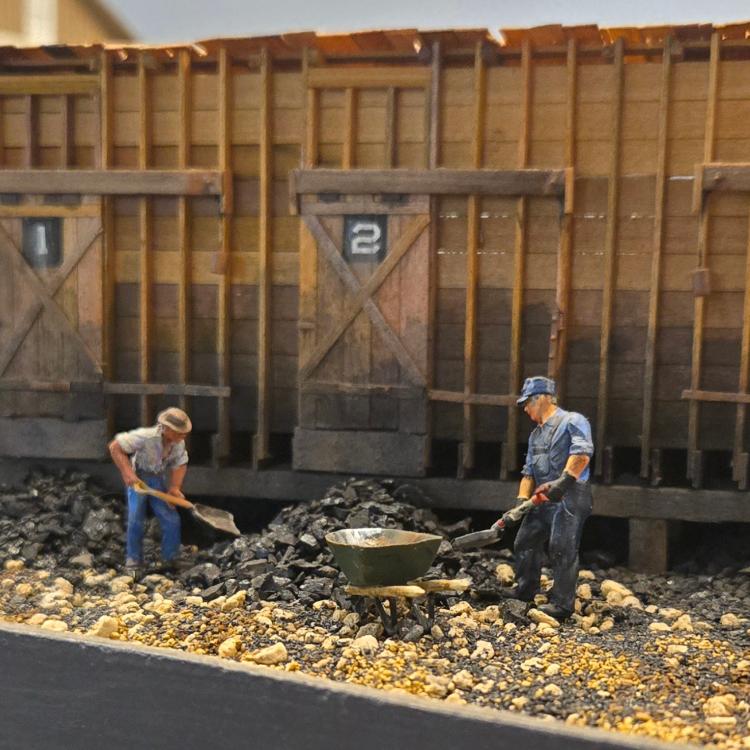
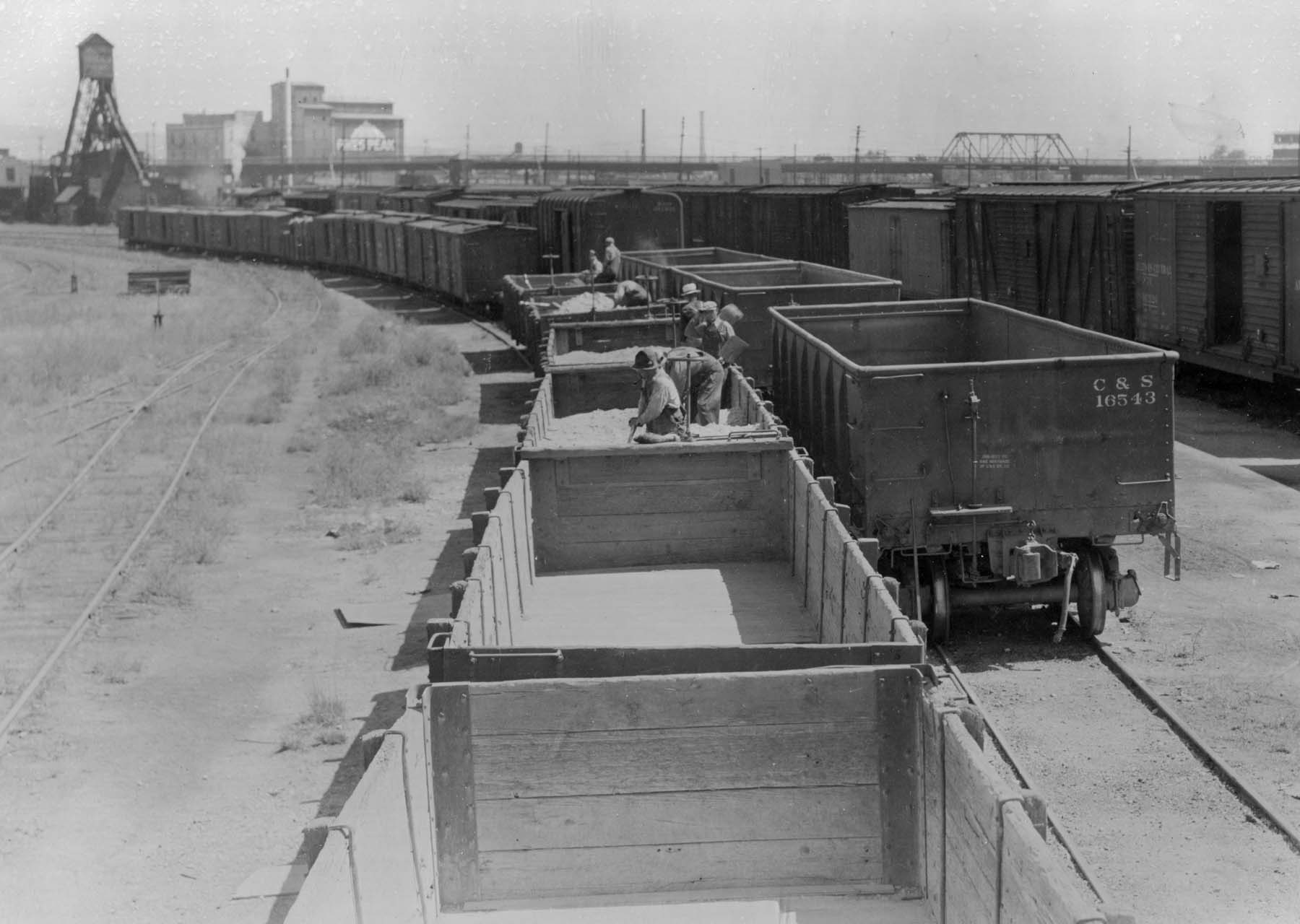
1. Labor was still cheap. There is a photo in the Narrow Gauge Pictorial of standard gauge gons and narrow gauge coals on parallel tracks and laborers were hand shoveling material from one car to the other. Ore is heavy enough that they would want to move it by gravity when possible, but coal, gravel and sand were probably all hand shoveled into the cars and out.

2. An empty car does not make money, so it stands to reason that loads of coal would go up the canon, and loads of ore would come back down. My Spidey sense tells me that more coal went up than ore went down. Also, I would want those laborers to really clean all that coal dust out of the cars before loading in ore. The coal was probably precious enough that this occured.

3. If you were trackside, it was pretty easy to have the car spotted and then have 4-10 fellows descend on it with shovels and unload it; even if you were across the street, a wagon became part of the process.

4. I don't know that we have unearthed much in the way of flimsys and paper on the C&S. (I am sure some material is out there, but my guess is that it is spotty: prove me wrong and start a new thread!) Once a coal was fair game in Black Hawk, or Central, or Idaho, or Silver Plume, I am sure the agent was aware and anxious to fill it with something--anything--and get it back to Denver.

5. Speaking of automation, this did not appear on the D&RGW till the 1920s and the advent of larger locomotives and longer trains. Approximately when the K-28s and K-36s were ordered we see the (3) Fairbanks Morse coaling towers at Gunny, Chama and Durango, and the Barrel Transfer being installed at Salida. Alamosa retained its massive coal trestle to the end, and coaling at Sargents, was similar to that at Pine Grove, Como, Dickey and Vance Junction.  Coal at the trestle bins was hand-shoveled from the car into the bin. What about loading coal into the coal tower in Denver and then dumping it in coals? No way: the roundhouse was a busy place, the top board of a coal is much lower than the rear of a tender, and there just is not the room for either the loads in or the loads out. Plus there is the matter of keeping track of the coal source and type (nut, stove and egg, for example).

The answer to your questions comes down to men with shovels.
Keith Hayes
Leadville in Sn3
Reply | Threaded
Open this post in threaded view
|

Re: C&S Coal Cars transferring in Black Hawk and Golden

Southpark
In reply to this post by Martin Wade
Keep in mind that at Golden there was a smelter and NG trackage from Golden to Denver smelters . Also there was a standard to narrow gauge transfer for large machinery etc near Union Station in Denver to enable items to be placed on NG cars for the trip up Clear Creek.
Tom Klinger
Reply | Threaded
Open this post in threaded view
|

Re: C&S Coal Cars transferring in Black Hawk and Golden

Dave Eggleston
In reply to this post by Martin Wade
Martin,

I think Keith's comments are spot on, especially the point that labor was cheap. A lot of coal and ore was handled by hand, either in bulk or bagged. The C&S and its predecessors were very profit focused and would only build infrastructure if it paid. A lot of businesses didn't have a spur, so teaming filled the gap.

The era you're looking at isn't the main period I focus on (1871-1899) but I'll offer some thoughts around coal shipments and ore handling.

The CCRR reached Blackhawk by Dec 1872 and coal was part of incoming traffic. There was only a team area at the original station and coal was loaded there by hand into wagons for transport. One spur along the road was extended at least once, maybe twice, along the main road to handle the expanding amount of coal coming in. Large operators like the Bobtail mine and mill were big customers and like everyone else were forced to team their coal from the spur. The only customer spur at the time was at the big smelter just east of the depot, perhaps the one place in Blackhawk coal cars would've been dropped directly at a customer until 1879.

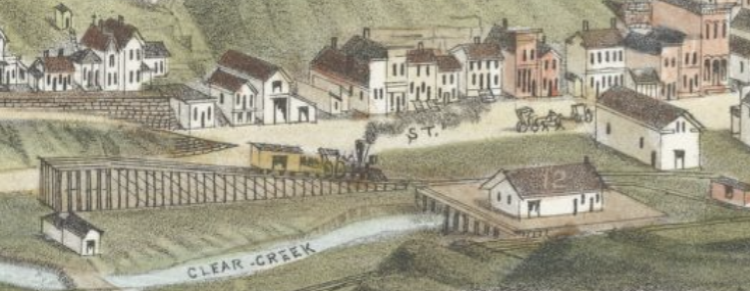
The UP wanted to establish itself as a coal supplier and after extending the line through BH to Central in 1878 coal trestles were built in Golden (SG transfer to NG), Blackhawk and Central--and drop bottom cars were purchased for the traffic. The trestles in BH and Central lasted about 6-7 years. There is one photo of the Central bin, and the Blackhawk bin can be seen on a birdseye map of 1882.

Around 1879 the big Bobtail Mill in BH had a spur with a coal bunker behind the mill. It used horse-drawn mine cars to haul the coal to the mill and up the hill to its various mines. The coal was dumped into the mine cars by gravity. Over time a very few other mines on the Central branch got spurs and accepted coal, in some cases offloaded by hand into chutes down to the mines. Spurs were expensive so rare.

Many larger operations also stockpiled coal on site for the winter, insurance against road and railroad closures. Coal was also seasonal and shipments may drop during times, especially for the residential business.

After the original 1880 coal trestles were pulled down I believe the drop bottom cars were standard gauged and moved elsewhere. Coal for the next 15 or so years was handled as it had been before 1880, mostly by hand.

Central City had a team coal spur in the small upper yard from the late 1880s that also existed after the new depot was built in 1899. I am not aware of a traditional rail-served dealer in Blackhawk or Central. There was at least one smallish coal shed in Blackhawk, tied to a local lumberyard, and a big bin was built at Central in the early 1900s. It was below grade on the slope by the small brick station and was loaded by hand from cars into rooftop sliding doors. Any local dealers teamed sacked or loose coal to their business.

The railroad, being cost focused, was inclined to use empty cars as much as possible. And that included using boxcars to ship ore (in piles over the bolster pins) when coal cars were unavailable or not secure enough. I don't doubt in-coming coal cars went back empty during slack periods but the railroad tried to avoid that. Sacked output from the mills was loaded in boxcars which might also cause an overage of coal car empties. The mining and milling traffic was very up and down, boom and bust and this affected how cars flowed in and out. Exactly how is somewhat of a mystery. The newspapers talk to numbers of outbound cars during busy periods but without any details beyond numbers. I also suspect in busy periods coal and box cars were stored in the Blackhawk yards as a buffer for the outbound traffic. So it is conceivable empty cars moved to Blackhawk from Golden.

The nature of what, and how, ore was shipped is also a bit complex and there's not a lot of surviving documentation. The key for the mines and mills was to keep shipping costs down and they did whatever was possible to reduce the weight of outbound loads, primarily by crushing ore to isolate the valuable gold/silver/etc in smaller loads. Larger mines had there own mill by the mine, somewhere in Black Hawk or elsewhere. Smaller (and poorer) mines teamed ore to mills that would do that smaller-order contract work. An even cheaper option was a sampling works, which Blackhawk had.

So some ore moved by team, but we might see a large operation shipping raw ore to a mill in Idaho Springs or elsewhere via the railroad. Wherever it was reduced, the ore still needed further processing and often left the mill in sacks, in boxcars. Those sacks went mostly to smelters in various locations, some located on the C&S, some elsewhere in the state, some in other states and at times even to England. Ore processing varies by the nature of the ore itself and there was no one smelter type.

This is a gross oversimplification of a complex and ever-changing business and the lack of consistency of ore shipments. The takeaway is that car use, types and quantities varied month to month over 70 years of railroad operation in Clear Creek. Despite best efforts, things often went slack and empty movements were part of the fallout.
Dave Eggleston
Seattle, WA
Reply | Threaded
Open this post in threaded view
|

Pictorial Supplement to C&S Coal Cars transferring in Black Hawk and Golden

Chris Walker
In reply to this post by Southpark
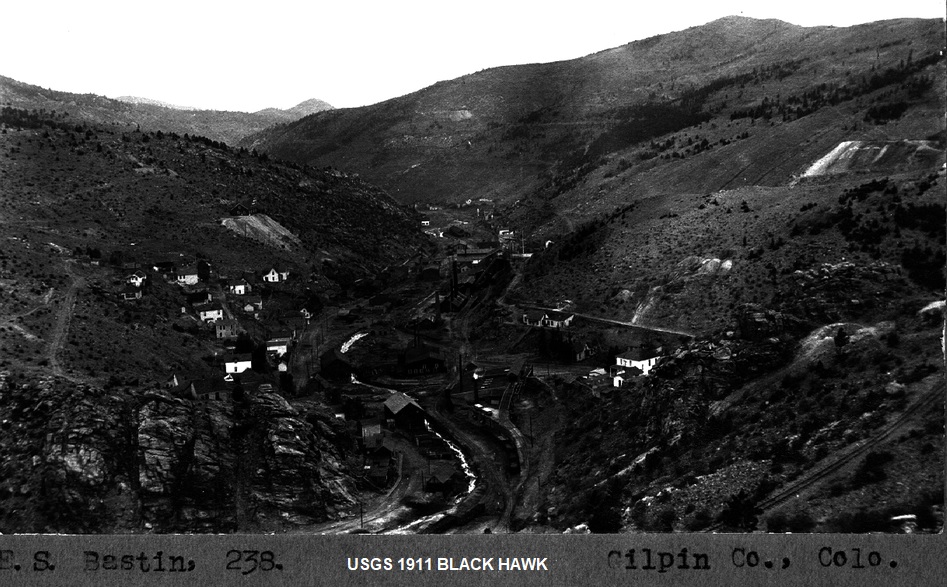
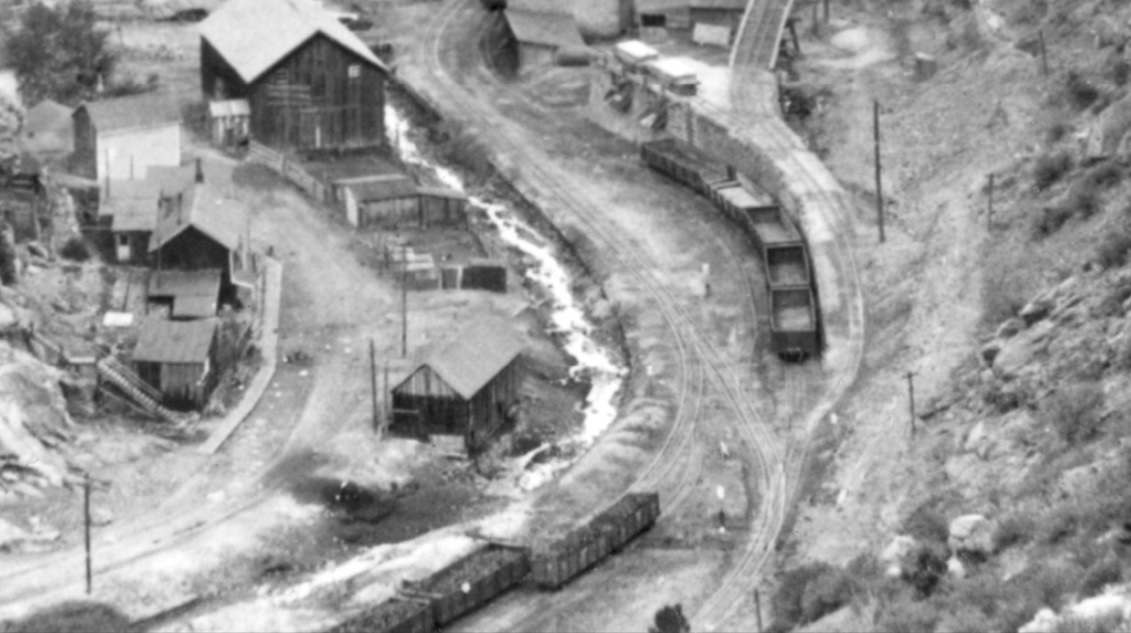
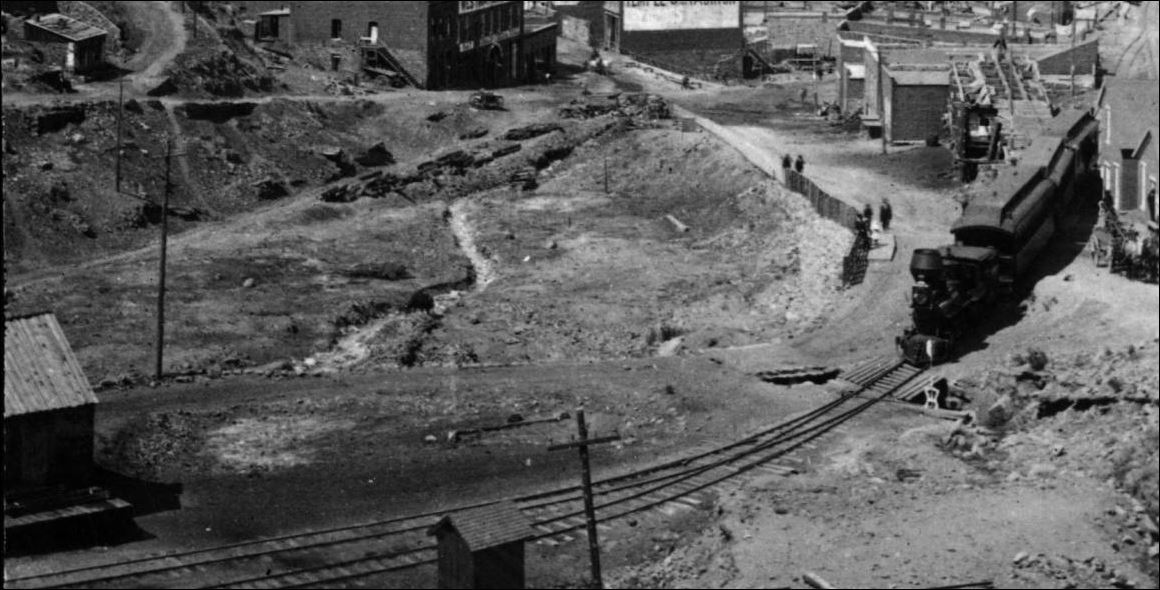
Black Hawk transfer in 1911: lower edge of image.  Image is also in Mineral Belt V-III and lightened.
USGS Photo


Denver Transfer, 1938
R. H. Kindig photo.  Image is also in Goin' Railroading; and Narrow Gauge Pictorial Vol-VIII.


Probably the only photo I've ever seen on a dump-over bin arrangement on the CC/DSP&P/C&S ever.
Central City


Get on 'em Banjoes.
UpSideDownC
in New Zealand
Reply | Threaded
Open this post in threaded view
|

Re: Pictorial Supplement to C&S Coal Cars transferring in Black Hawk and Golden

Ken Martin
My grandfather managed a lumber company. My father told me a story of a young guy who was given a choice of unloading a car of coal or a car of pea gravel. He looked in both and took the pea gravel because the level was lower and he had a hot date that night. He didn't realize gravel was heavier.  He didn't make his date.
Reply | Threaded
Open this post in threaded view
|

Re: Pictorial Supplement to C&S Coal Cars transferring in Black Hawk and Golden

Martin Wade
Thanks so much to all the information shared, including the funny story at the end.   That really gives me a lot of "surrounding" information to the framework I was working from.   This gives me a lot to work from as I develop my Operations plan.
I had never seen the one photo of the central city bin.  This last week I stumbled on the picture of hand loading in Denver which really surprised me at that timeframe.   The lightened picture and a couple others of the ore chutes have been my primary sources for the Gilpin operations for commodity transfer.
At the end of the day, clearly "hand transfer" was the main process which means only a couple side by side tracks are needed.  I never thought about some empties still moving back so that might be interesting to work in occasionally.

Thanks so much for sharing all this information.

Very appreciated,

Martin
Reply | Threaded
Open this post in threaded view
|

Re: Pictorial Supplement to C&S Coal Cars transferring in Black Hawk and Golden

Dave Eggleston
I agree with Chris about the Central City 1880-1886 coal drop--that's the only photo I've seen of it.

Found the 1882 Blackhawk birdseye map at DPL (DPL CG4314 B32 A3 1882 S7) that shows the coal drop there, right next to the depot. Here's a detail close-up:


Removed I think in 1886, to make room for spurs in the location.
Dave Eggleston
Seattle, WA
Reply | Threaded
Open this post in threaded view
|

Re: Pictorial Supplement to C&S Coal Cars transferring in Black Hawk and Golden

Dave Eggleston
In reply to this post by Martin Wade
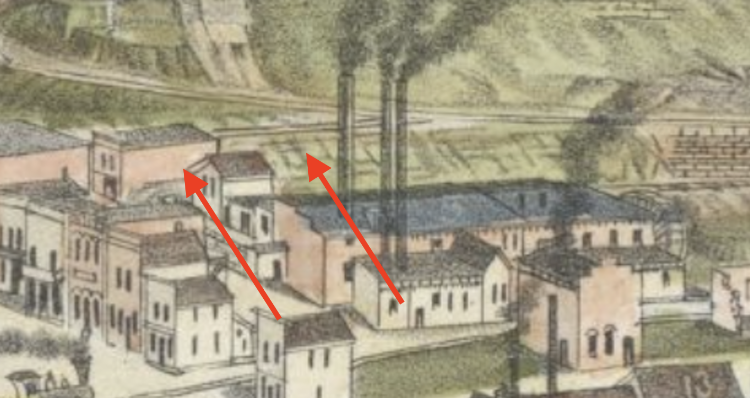
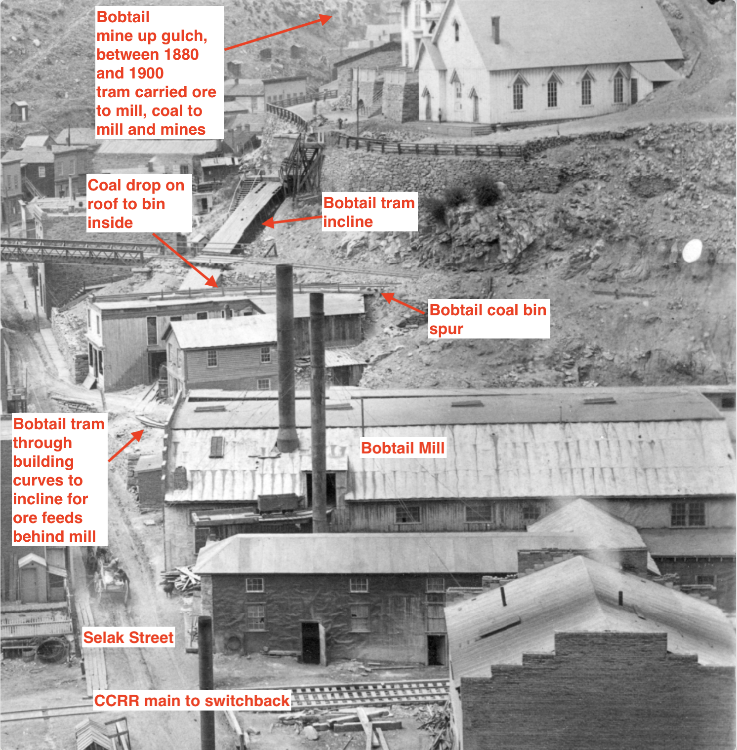
And also seen on the map is the Bobtail's coal spur and coal drop, which was inside an older store building! They gutted it and put a bin inside, ran tracks onto the roof and the mine and mill's ore tram ran through the walls under it.


The railroad viaduct over Blackhawk on the Central City branch was just to the left of this spur, cropped off this detail.

This was used on and off until the big remodel of the mill and new tram around 1900.
Dave Eggleston
Seattle, WA
Reply | Threaded
Open this post in threaded view
|

Re: Pictorial Supplement to C&S Coal Cars transferring in Black Hawk and Golden

Dave Eggleston
In reply to this post by Martin Wade
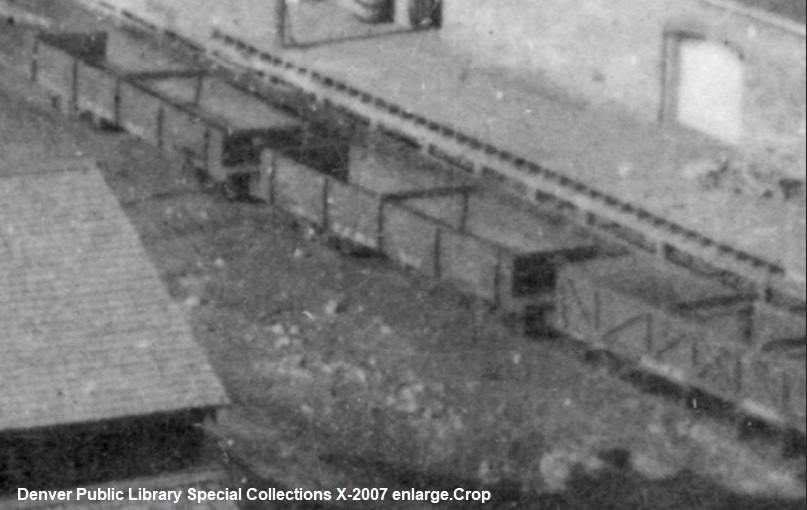
And a good image of the Bobtail's hidden-in-plain sight gravity coal bin. DPL x-2008.


And a close look behind the foremost smoke stack shows the tram emerging from the upper level of the mill, with one of their distinctive ore cars on the short trestle. I speculate that coal was dropped inside at this level from the tram cars. Everything here was gravity-based and expensive to implement but the Bobtail's expanding operations helped fund and justify things.
Dave Eggleston
Seattle, WA
Reply | Threaded
Open this post in threaded view
|

Re: Pictorial Supplement to C&S Coal Cars transferring in Black Hawk and Golden

Chris Walker
Apparently some brain cells have left the building, Dave.  
I'd forgot clean about the Black Hawk coaldrop off the switchback http://c-sng-discussion-forum.254.s1.nabble.com/End-of-track-arrangements-tp4186p4199.html

I think these were the only CC RR hoppers at that time, and after all, Martin asked about "Coalcars" specifically.


Labour was cheap don't forget: old, infirm or otherwise were given jobs doing menial tasks such as unloading on an as needed basis.  There would have been an Office somewhere where these Men would have assembled bright and early, in every Town and City.  It wasn't until the late 1890's that solutions to rising labour costs were sought.  Some places on account of available low-wage masses stuck with the hand bombing. Denver on the C&S; Montrose on the D&RGW.
UpSideDownC
in New Zealand
Reply | Threaded
Open this post in threaded view
|

Re: Pictorial Supplement to C&S Coal Cars transferring in Black Hawk and Golden

Dave Eggleston
Yep, those were the only bottom dumping coal cars I know of on the early Colorado Central narrow gauge. The ramp in Blackhawk, the drop in Central and very possibly the drop at the Bobtail mill all were the main users of the drop bottom cars.

The other open cars in the line are technically "coal cars" also--that's what they were called in that era despite carrying coal and everything else.

Mining districts sure weren't short of unemployed men who knew how to use shovels and likely to take up the low pay, compared to working in a productive mine, in slack times. I understand the Carson & Colorado used a lot of out of work miners for the initial grading, work that paid a quarter of what they'd been making during the boom times. That drop in pay didn't sit well with the miners (about $1 a day after board versus $4 in the mines), they struck for more and were offered a train ride back to Virginia City where there was...no work. Quite a few opted for the lower pay and stayed put.  

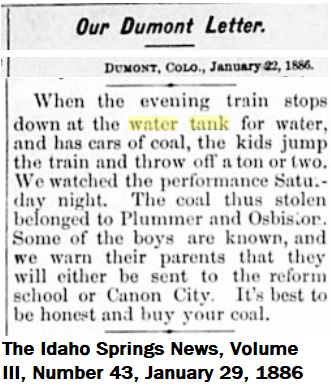
One other way cars were unloaded we know is locals pilfering coal by hand at night, especially in quiet, remote towns. Hand unloading in it's least legal sense.
Dave Eggleston
Seattle, WA
Reply | Threaded
Open this post in threaded view
|

Re: Pictorial Supplement to C&S Coal Cars transferring in Black Hawk and Golden

Chris Walker
Dave Eggleston wrote
One other way cars were unloaded we know is locals pilfering coal by hand at night, especially in quiet, remote towns. Hand unloading in it's least legal sense.
Our term for that was "shrinkage".

UpSideDownC
in New Zealand