Re: Beaver Brook Caboose
Posted by Jim Courtney on
URL: http://c-sng-discussion-forum.254.s1.nabble.com/Caboose-numbers-quickly-diverged-to-Tiffany-Reefers-tp6376p6404.html
Okay, Todd, I got home from the hospital, dug out my files and fired up my computer to access photos, so let's discuss your original question.
In his multipart series in Outdoor Railroader (August 1995 - January 1996), Derrell Poole identified the "Caboose" in this photo as DSP&P number 79, built in January, 1884. But I doubt that Derrell had access to a photo of this quality resolution (the photos in the articles are near postage stamp size). In the drawings in Part 2 of the series, he drew car 79 with the larger 4-pane, double-hung windows, curved hand grabs, and showed the arched "Caboose" lettering as shown. He felt that the car had quarter-round passenger car style corners and drew the corner platform steps as having the familiar solid sides, as on later C&S cabooses.
But in studying the enlargement you provided, it looks to me as if the steps had open sides, as on earlier South Park way cars, like the famous photo of number 64 at Hancock:
http://cdm16079.contentdm.oclc.org/cdm/fullbrowser/collection/p15330coll22/id/76301/rv/singleitem

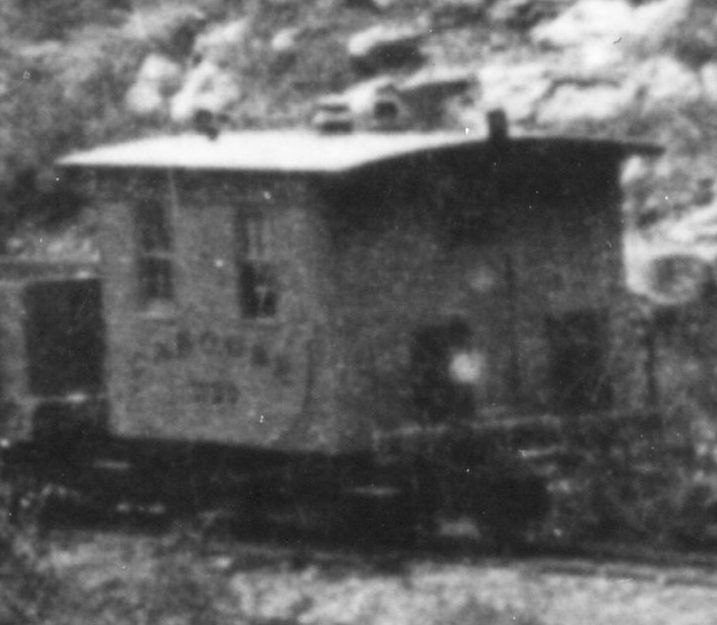
I can't tell from your enlargement about the caboose corners, but I think I see small corner irons at the bottom of the body's corner. The lettering and numbers are hard to read for certainty, as there is some blurring. Derrell read this as a blurred number 79. To me, it looks like at least 3, more likely 4 digits, the two digits to the left being skinny. The arched "Caboose" above isn't that blurred to account for a two digit number being blurred to 3 or 4 digits. And the lettering on the fascia looks more complicated than just DSP&P initials--could it read "Union Pacific" or "Colorado Central"? (DL&G and UPD&G aren't possibilities yet at this date).
As to my best guess, there was another class of way cars with 4-pane, double-hung windows, curved hand grabs and corner irons at the bottom of the body corners, the two cars built by the UP in the fall of 1883 for the Colorado Central. After the 1885 renumbering, they became cars 1725 and 1726. IMHO, the photo is of one of the two Colorado Central cars, after renumbering.
As to paint scheme, I copied a drawing I believe was posted by the California Railroad Museum--I apologize, I've lost the link:
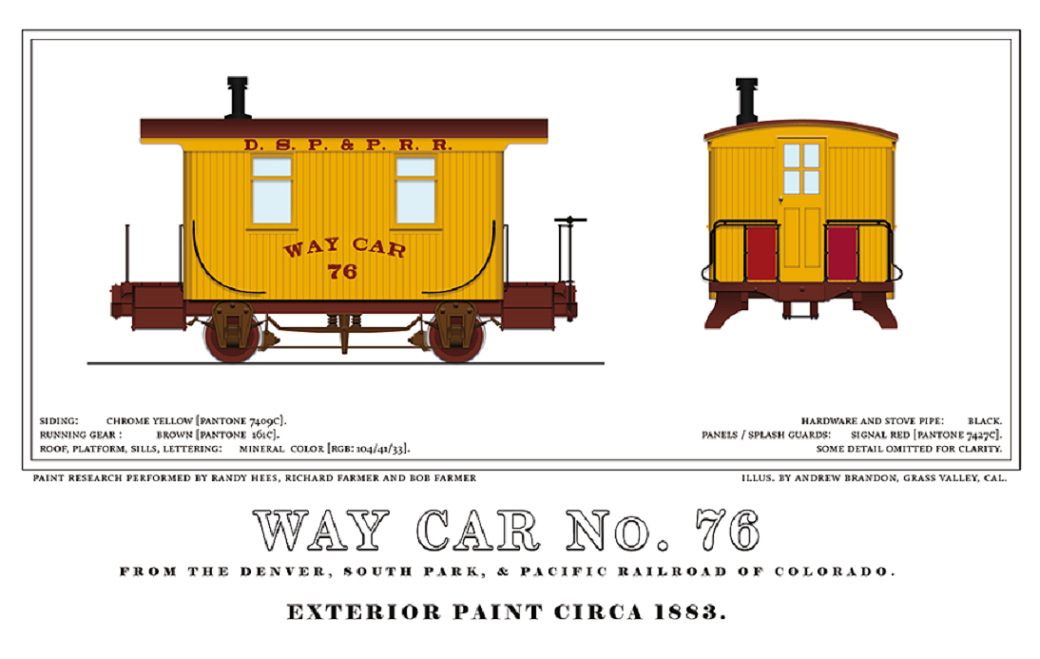
It is a paint illustration prepared by Randy Hess and others, based on standard UP paint specifications for cabooses in the mid 1880s. The paint scheme closely matches the actual paint uncovered during the C&S 1006 restoration: http://c-sng-discussion-forum.41377.n7.nabble.com/C-amp-S-1006-Restoration-Photos-td879.html
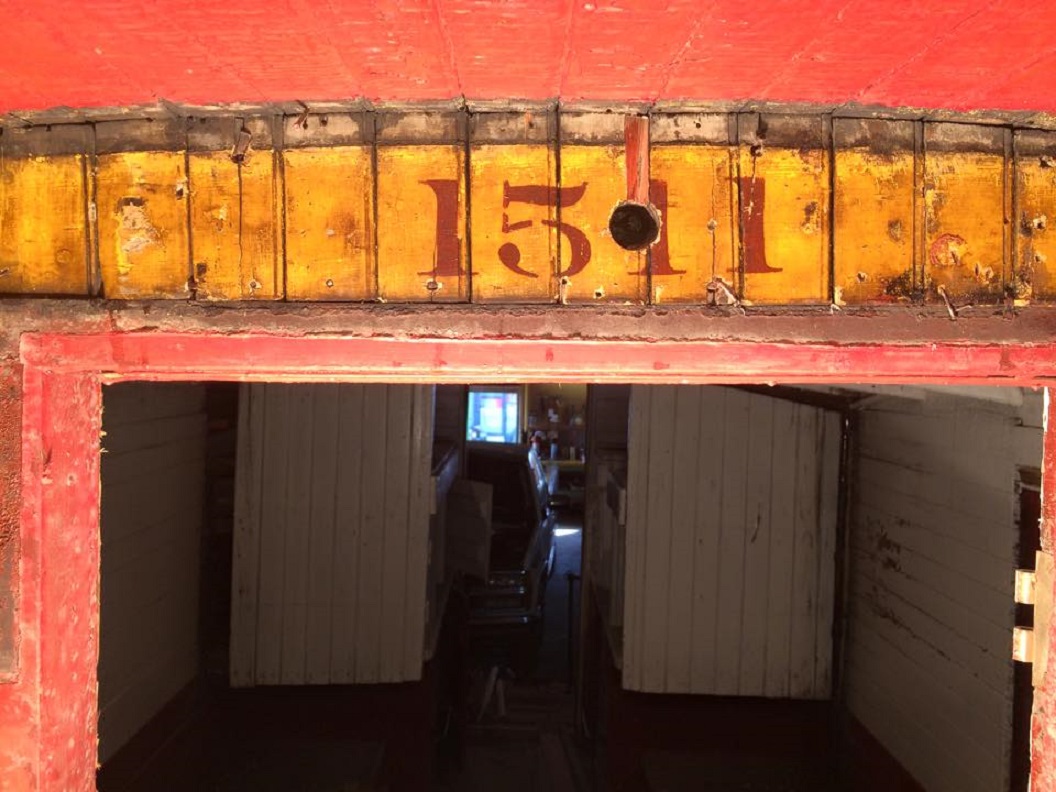
(another view of the scheme worn by DL&G 1511)
Anyways, that's my two-cents worth.
Before I close let's talk about those two vertical panels suspended in the end railings. Everyone seems to think they were signaling panels, painted red (as above), to alert approaching locomotives from the rear, to avoid collisions at night.
In your photo and others, they always look black to me. I know that red on old emulsions was rendered dark, but the two end panels on your photo are much darker than the boxcar red freight cars. Consider:
http://cdm16079.contentdm.oclc.org/cdm/singleitem/collection/p15330coll21/id/12601/rec/156
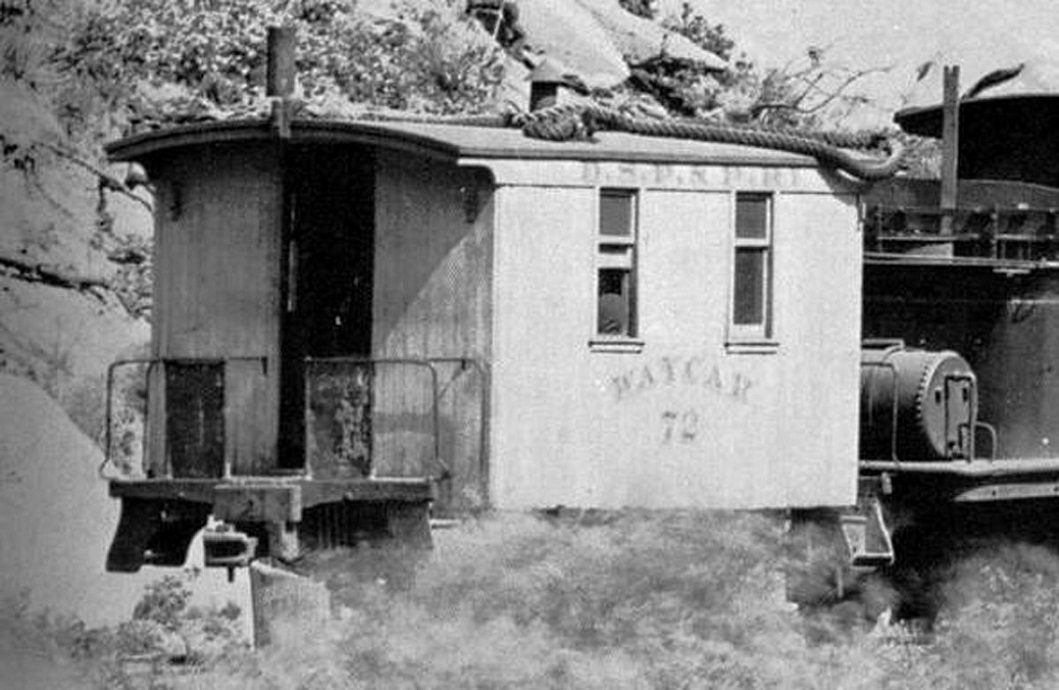
Not only do the end panels look dark (if not black, brown maybe?), but they are pretty scarred and beat up. Since the vertical center line of each panel is exactly 3 feet apart on Derrell's drawings, I think the panels served another function: To keep debris from the car wheels ahead (rocks, gravel, snow, ice, mud) from being thrown up onto the caboose platform and end wall / door.
That's right, I believe the South Park invented the predecessor of the modern "mud flap", seen on hundreds of thousands of eighteen-wheelers across the nation today.
Thoughts?
URL: http://c-sng-discussion-forum.254.s1.nabble.com/Caboose-numbers-quickly-diverged-to-Tiffany-Reefers-tp6376p6404.html
Okay, Todd, I got home from the hospital, dug out my files and fired up my computer to access photos, so let's discuss your original question.
In his multipart series in Outdoor Railroader (August 1995 - January 1996), Derrell Poole identified the "Caboose" in this photo as DSP&P number 79, built in January, 1884. But I doubt that Derrell had access to a photo of this quality resolution (the photos in the articles are near postage stamp size). In the drawings in Part 2 of the series, he drew car 79 with the larger 4-pane, double-hung windows, curved hand grabs, and showed the arched "Caboose" lettering as shown. He felt that the car had quarter-round passenger car style corners and drew the corner platform steps as having the familiar solid sides, as on later C&S cabooses.
But in studying the enlargement you provided, it looks to me as if the steps had open sides, as on earlier South Park way cars, like the famous photo of number 64 at Hancock:
http://cdm16079.contentdm.oclc.org/cdm/fullbrowser/collection/p15330coll22/id/76301/rv/singleitem
I can't tell from your enlargement about the caboose corners, but I think I see small corner irons at the bottom of the body's corner. The lettering and numbers are hard to read for certainty, as there is some blurring. Derrell read this as a blurred number 79. To me, it looks like at least 3, more likely 4 digits, the two digits to the left being skinny. The arched "Caboose" above isn't that blurred to account for a two digit number being blurred to 3 or 4 digits. And the lettering on the fascia looks more complicated than just DSP&P initials--could it read "Union Pacific" or "Colorado Central"? (DL&G and UPD&G aren't possibilities yet at this date).
As to my best guess, there was another class of way cars with 4-pane, double-hung windows, curved hand grabs and corner irons at the bottom of the body corners, the two cars built by the UP in the fall of 1883 for the Colorado Central. After the 1885 renumbering, they became cars 1725 and 1726. IMHO, the photo is of one of the two Colorado Central cars, after renumbering.
As to paint scheme, I copied a drawing I believe was posted by the California Railroad Museum--I apologize, I've lost the link:
It is a paint illustration prepared by Randy Hess and others, based on standard UP paint specifications for cabooses in the mid 1880s. The paint scheme closely matches the actual paint uncovered during the C&S 1006 restoration: http://c-sng-discussion-forum.41377.n7.nabble.com/C-amp-S-1006-Restoration-Photos-td879.html
(another view of the scheme worn by DL&G 1511)
Anyways, that's my two-cents worth.
Before I close let's talk about those two vertical panels suspended in the end railings. Everyone seems to think they were signaling panels, painted red (as above), to alert approaching locomotives from the rear, to avoid collisions at night.
In your photo and others, they always look black to me. I know that red on old emulsions was rendered dark, but the two end panels on your photo are much darker than the boxcar red freight cars. Consider:
http://cdm16079.contentdm.oclc.org/cdm/singleitem/collection/p15330coll21/id/12601/rec/156
Not only do the end panels look dark (if not black, brown maybe?), but they are pretty scarred and beat up. Since the vertical center line of each panel is exactly 3 feet apart on Derrell's drawings, I think the panels served another function: To keep debris from the car wheels ahead (rocks, gravel, snow, ice, mud) from being thrown up onto the caboose platform and end wall / door.
That's right, I believe the South Park invented the predecessor of the modern "mud flap", seen on hundreds of thousands of eighteen-wheelers across the nation today.
Thoughts?
Jim Courtney
Poulsbo, WA
Poulsbo, WA
| Free forum by Nabble | Edit this page |