Re: Leadville Flanger.
Posted by Keith Hayes on
URL: http://c-sng-discussion-forum.254.s1.nabble.com/Flanger-015-tp19711p19817.html
First off, I'm not a railroader, so I will dive into the abyss of the little I know.
1. Couplers are really heavy. I could not lift one myself, and it would pretty much obliterate my entire foot if I were able to lift one and accidentally dropped it. The part we see is the tip of the iceberg: the shaft extends into and under the frame and is bolted to a "U" shaped piece of steel top and bottom. There is a spring for some cushioning, and the weight is, in part, supported by a piece of iron below the shank and behind the head. The rest of the particulars, I have forgotten as it was a dark space under the flat car.
2. Pat, thanks for the reminder of the two gons with 3-way pockets. High time someone model these!!! Note that this casting has a VERY LARGE plate behind it, and the coupler looks like an American Flyer-sized affair with a large shank in the form of an "E" to mate with the pressed cylinder of the casting which forms a "c". A pin would hold this in place, and the knuckle could be moved from one position to the other two, ideally using a engine lift so as to avoid aforementioned foot injuries. Oh, and on the drawing Pat provided, the VERY LARGE plate is firmly attached to MULTIPLE END BEAMS with LOTS OF BOLTS. (During my short stint as a Carman, I observed that wood rolling stock starts with lots of large, solid, heavy pieces of wood that steadily become lighter as they are drilled and carved and filled with lots of holes, mortices and tenons.)
3. Generally the drawbar fits in the gap created by the two center sill pieces, usually about a foot apart on NG equipment. Note on wood cars the ends of the center sills are oak--dense to withstand crushing abuse, and these are fitted to the middle part of the center sills which are spruce, which is good in tension. You can see this splice on your models when you turn the car over and see three bolts on each center sill between the needle beam and the inboard axle. But make sure you don't pick an SUF model by mistake--you will not find the detail there!
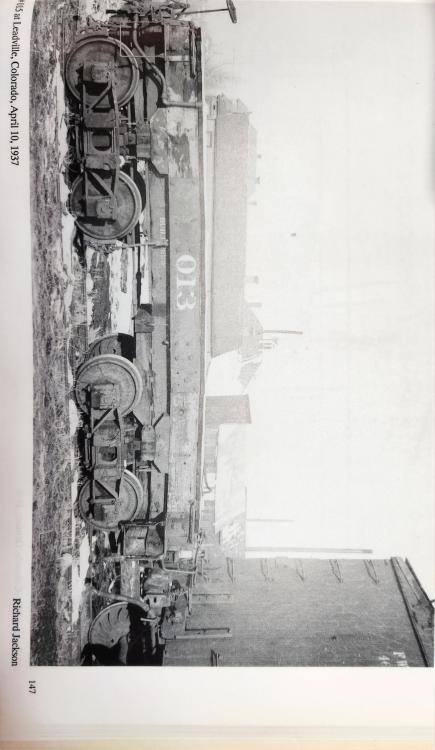
4. On the Flanger 013, there are two center sills low on the car, with four more sills above that. There is a single end beam, and not really enough material to hang the VERY LARGE casting on, IMHO. If the shank is moved up for the SG coupler, the center sill would need to be adjusted too. Not to mention, the casting and the American Flyer knuckle might cause the 'A' end of the car to nosedive some. It is hard to tell from the photo if the end sill has been supplemented. 013 no longer has all those heavy castings to move the blades up and down, and it lacks the blades too. Maybe they added a 12x12 end beam below? Oh, the car does have two truss rods, which is about the only thing that keeps the works together.
5. Mental math tells me that the center line of couplers is about 10 1/4" off from narrow to standard gauge. I have to ask, is that too far to push the coupler casting over for an SG car? This does not explain the alignment of the coupler with the FW&D coupler though.
6. The drawing Pat provided has an early date, and 013 was likely modified in the 20s. How many of these castings might Burnham have made? I recall seeing one on an SG 0-6-0. There were two on the gons, and doubtless others. Did the C&S use a similar casting on the Leadville switcher that might have been adapted to 013 with an AF coupler? Writing all these out, I am thinking 013's 'A' end was retrofitted with some recycled end beam material below the upper sills and one of the old locomotive castings was located and installed with the corresponding coupler. I think I see some are below the 'B' end wheels in the photo.
So many questions. I am probably going to stick with plain old Kadees at the NG height between the sills. I know Jim desperately wants me to put down some third rail, but I need to get this @$%^& Rolling Stock AP done and get started on the helix. If track doesn't make it to Climax the whole enterprise is shot!
URL: http://c-sng-discussion-forum.254.s1.nabble.com/Flanger-015-tp19711p19817.html
First off, I'm not a railroader, so I will dive into the abyss of the little I know.
1. Couplers are really heavy. I could not lift one myself, and it would pretty much obliterate my entire foot if I were able to lift one and accidentally dropped it. The part we see is the tip of the iceberg: the shaft extends into and under the frame and is bolted to a "U" shaped piece of steel top and bottom. There is a spring for some cushioning, and the weight is, in part, supported by a piece of iron below the shank and behind the head. The rest of the particulars, I have forgotten as it was a dark space under the flat car.
2. Pat, thanks for the reminder of the two gons with 3-way pockets. High time someone model these!!! Note that this casting has a VERY LARGE plate behind it, and the coupler looks like an American Flyer-sized affair with a large shank in the form of an "E" to mate with the pressed cylinder of the casting which forms a "c". A pin would hold this in place, and the knuckle could be moved from one position to the other two, ideally using a engine lift so as to avoid aforementioned foot injuries. Oh, and on the drawing Pat provided, the VERY LARGE plate is firmly attached to MULTIPLE END BEAMS with LOTS OF BOLTS. (During my short stint as a Carman, I observed that wood rolling stock starts with lots of large, solid, heavy pieces of wood that steadily become lighter as they are drilled and carved and filled with lots of holes, mortices and tenons.)
3. Generally the drawbar fits in the gap created by the two center sill pieces, usually about a foot apart on NG equipment. Note on wood cars the ends of the center sills are oak--dense to withstand crushing abuse, and these are fitted to the middle part of the center sills which are spruce, which is good in tension. You can see this splice on your models when you turn the car over and see three bolts on each center sill between the needle beam and the inboard axle. But make sure you don't pick an SUF model by mistake--you will not find the detail there!
4. On the Flanger 013, there are two center sills low on the car, with four more sills above that. There is a single end beam, and not really enough material to hang the VERY LARGE casting on, IMHO. If the shank is moved up for the SG coupler, the center sill would need to be adjusted too. Not to mention, the casting and the American Flyer knuckle might cause the 'A' end of the car to nosedive some. It is hard to tell from the photo if the end sill has been supplemented. 013 no longer has all those heavy castings to move the blades up and down, and it lacks the blades too. Maybe they added a 12x12 end beam below? Oh, the car does have two truss rods, which is about the only thing that keeps the works together.
5. Mental math tells me that the center line of couplers is about 10 1/4" off from narrow to standard gauge. I have to ask, is that too far to push the coupler casting over for an SG car? This does not explain the alignment of the coupler with the FW&D coupler though.
6. The drawing Pat provided has an early date, and 013 was likely modified in the 20s. How many of these castings might Burnham have made? I recall seeing one on an SG 0-6-0. There were two on the gons, and doubtless others. Did the C&S use a similar casting on the Leadville switcher that might have been adapted to 013 with an AF coupler? Writing all these out, I am thinking 013's 'A' end was retrofitted with some recycled end beam material below the upper sills and one of the old locomotive castings was located and installed with the corresponding coupler. I think I see some are below the 'B' end wheels in the photo.
So many questions. I am probably going to stick with plain old Kadees at the NG height between the sills. I know Jim desperately wants me to put down some third rail, but I need to get this @$%^& Rolling Stock AP done and get started on the helix. If track doesn't make it to Climax the whole enterprise is shot!
Keith Hayes
Leadville in Sn3
Leadville in Sn3
| Free forum by Nabble | Edit this page |