Re: The Gilpin Tram in Black Hawk
Posted by Keith Pashina on
URL: http://c-sng-discussion-forum.254.s1.nabble.com/The-Gilpin-Tram-in-Black-Hawk-tp18436p19534.html
A LOOK AT THE POLAR STAR MILL
The Polar Star Mill was literally right next to the ore transfer chutes. The transfer chutes were built to easily dump smelter-quality ore that was going into C&S gondolas for shipment elsewhere. The ore mined along the Gilpin Tram tended to be divided into mill-grade ore (lower metal values), and the cars of smelter ore (higher grade)
. I speculate the ore chutes were located here because of a convenient space for a 2’ gauge spur and because the track was up on a trestle already, to reach the Polar Star Mill. Photographs from the era show that the ore chutes were built from timber, and later mostly filled in with dirt and rock. The chutes were just that – a metal trough where Gilpin Tram ore cars dumped directly into a waiting C&S gondola below – there was no storage bin or chute gate. A pair of ore chutes was constructed, spaced for two Gilpin Tram ore cars, and the entire ore chutes spur was only long enough for two ore cars. Very simple, compact, and an ideal scene to model.
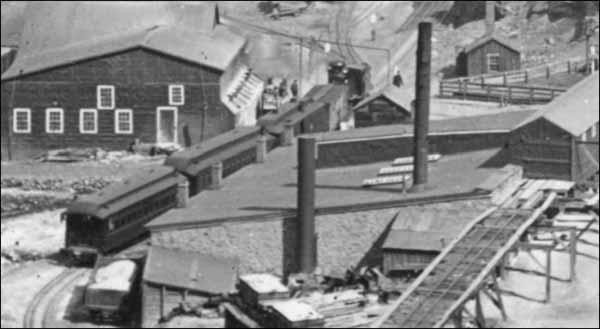
This enlargement of a photo is from the Denver Public Library, Western History Collection. A C&S passenger train to Central City is passing the Polar Star Mill. A loaded C&S gondola may have been loaded from the ore chutes, and dropped by gravity to in front of the Polar Star Mill. There are 2 loaded Gilpin Tram ore cars sitting on the ore chutes track, waiting to be dumped into C&S gondolas. The trestlework at right supports the Gilpin's 2' gauge unloading spur. The doors are shut on the structure where the cars were unloaded. This structure is actually a warming shed, heated by steam pipes in winter for thawing frozen ore in the Gilpin cars
The Polar Star Mill is a distinctive structure, still standing today. The Polar Star Mill actually is the 2nd structure on this site, and replaced an earlier wooden mill, and was likely built in the 1870s. The existing mill is a simple structure, with stone walls and a post and beam-supported sloping roof. Unlike what we think as a “typical” mill, the Polar Star Mill was built on a relatively level site and does not have the typical cascading construction of a building constructed on the side of a hillside, The mill walls are about 2’ thick rough stonewalls, mortared together with local stone on the nearby mountainsides. The Polar Star Mill was built before construction of the Gilpin Tram, so when the tramway was built, the spur to the mill was built on a wooden trestle above the driveway for horse-drawn wagons to also deliver ore to the mill. That same trestle also had a warming shed for thawing out frozen ore cars in the winter, before dumping into the mill.
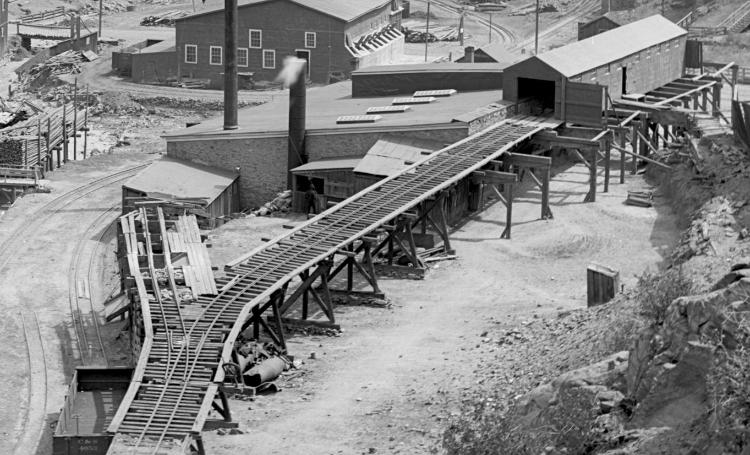
Here is a closer view of the ore chutes as originally built. The trestle work on the approach and ore chutes spur were later infilled with soil and rock walls. Note the simple metal chute for dumping ore into C&S cars.
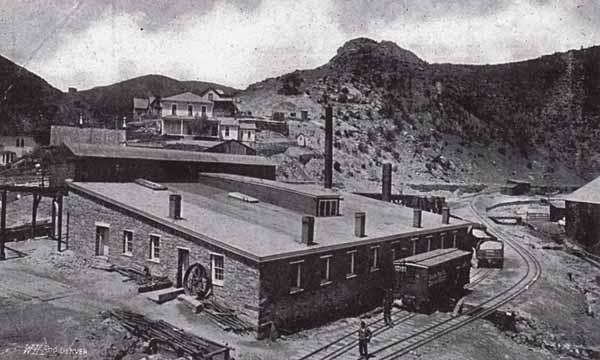
This view is from the Ronzio collection, and published in the Gilpin Railroad Era. A UPD&G boxcar is parked on the dual gauge track in front of the Polar Star Mill. Two or more loaded 3' gauge gondolas can be seen behind it. This is also a nice view of the south end of the Gilpin Tram unloading trestle and warming shed.
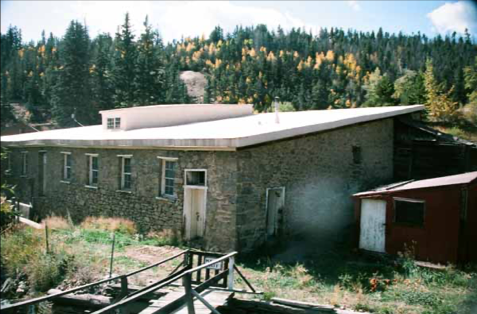
Here is the Polar Star Mill about 25 years ago. It is privately owned by the Blake family, and has been in that family for many decades. This is a wonderful example of stone wall construction. The present roof is a new membrane, and not the original roof material (I don't know what the original roof covering was). The present owners worked with a Colorado preservation group, and a grant repointed the stone walls, replaced the roof, and other work to restore and protect the building.
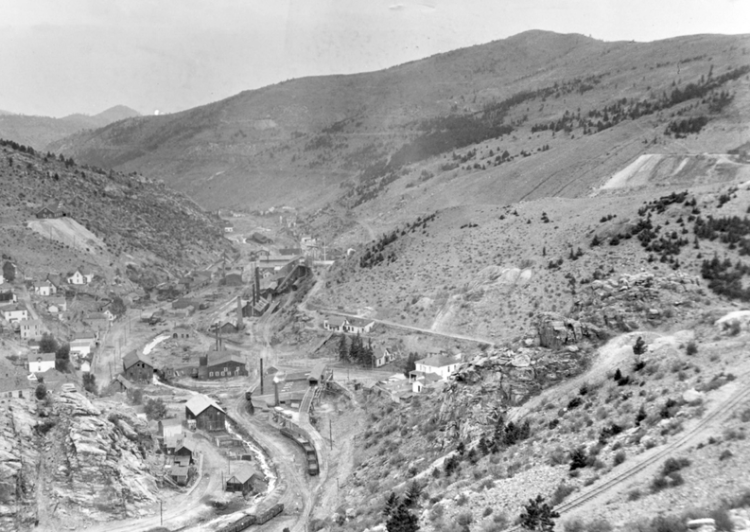
In this photo, the bottom center of the photo shows a string of 5, C&S coal cars parked on the siding next to the ore transfer chutes. Two Gilpin Tram ore cars can be seen on the ore transfer trestle above, still loaded. At the bottom center photo edge, two C&S coal cars are parked on the siding next to the Gilpin Tram transfer - two Gilpin coal cars are parked on the track where coal was hand shoveled from the 3' gauge to the 2' gauge. Black Hawk lies in the valley beyond the Polar Star Mill.

This is a similar view to the previous photo, showing Black Hawk 23 years ago. There has been even more casino development and construction since then. A lot has changed in the past 100 years. However, the Polar Star Mill still stands - it can be seen with the light-colored roof, immediately above the green-roofed municipal building in right foreground
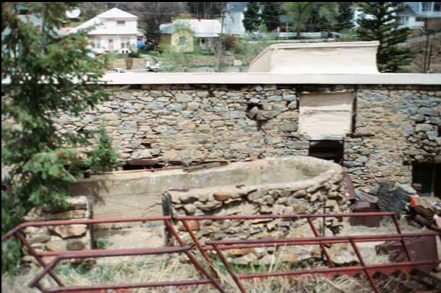
This view is looking east at the west wall of the Polar Star Mill. The bathtub-shaped stone enclosure in the foreground was the end of the water flume, which diverted water for Clear Creek during high creek flows, and was used to power an interior water wheel that powered the stamps and machinery
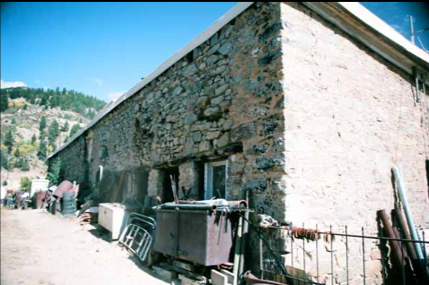
This is the business side of the Polar Star Mill - the Gilpin Tram ore trestle would have been on the left side of this photo, above the "road". The small doors on this wall are for unloading ore into the mill. The Polar Star Mill predates the construction of the Gilpin Tram. The ore trestle for the 2' gauge spur was a late addition, and an unusual ore chute arrangement was used to unload ore cars - I will explain in more detail, later
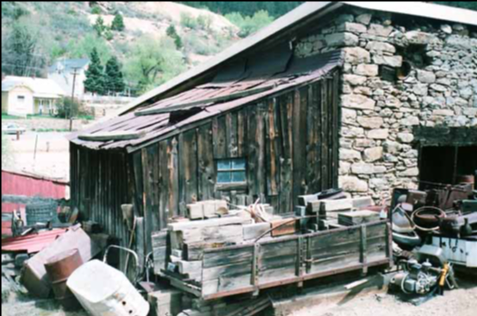
This is the northwest end of the Polar Star Mill, about 15 years. I had special permission from Norm Blake, then his son Kent, to be on the their property to photograph the mill. This little wood addition was possibly a stable for mules/horses
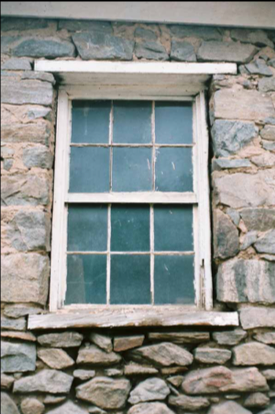
This view shows the stacked stone construction, mortared together. This photo was taken about 15 years ago, before a recent repair/restoration of the mill building. The eroded mortar joints have since been repointed. Note the heavy wooden window sill, and lintel at the top of the window. The stone walls are about 2' thick, so the lintels and sills are built of heavy wooden boards laid side-by side
How big was the Polar Star mill? Well, the 1902 Mining Reporter Magazine reported the mil was operating 40 "slow-drop" stamps, and had a capacity of 40 tons per day. That equates to about 4 to 5 Gilpin Tram ore cars, but this mill also received ore from wagon teams, so this makes the mill a very-modelable size.
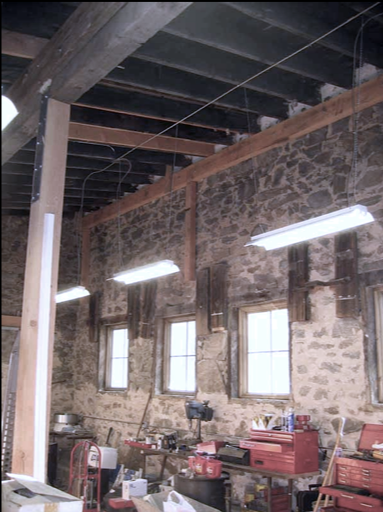
This view shows the inside of the Polar Star, after historic restoration. The mortared stone walls are clearly visible. The current owner uses part of the mill as a workshop
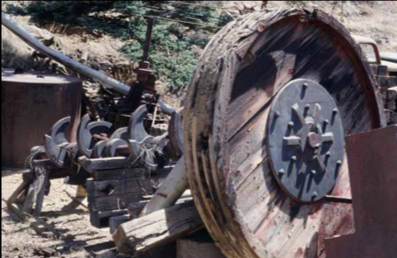
About 30 years ago, the Blake family had several parts of mill machinery laying on the ground next to the Polar Star Mill. Norm Blake told me in about 1992 that this cam and bull wheel were from a slow-drop stamp originally from the Randolph Mill (which is further south along Clear Creek and the subject of a future post)
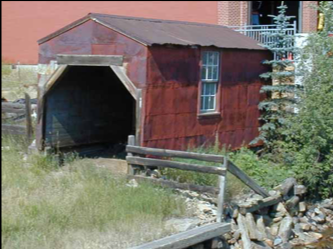
This little shed was modified by the Blake family and used as a donkey barn when I first saw it in 1990. Norm Blake told me at one time, this little structure was the mill office for the Randolph Mill
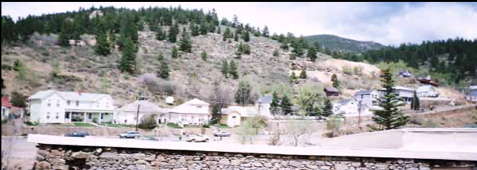
This photo is looking east, looking over the Polar Star Mill building. Black Hawk residences, many which date back 100 years or more, are on the opposite side of Clear Creek. The home at far left was the Blake home, and apparently has been in their family since the late 1800s
URL: http://c-sng-discussion-forum.254.s1.nabble.com/The-Gilpin-Tram-in-Black-Hawk-tp18436p19534.html
A LOOK AT THE POLAR STAR MILL
The Polar Star Mill was literally right next to the ore transfer chutes. The transfer chutes were built to easily dump smelter-quality ore that was going into C&S gondolas for shipment elsewhere. The ore mined along the Gilpin Tram tended to be divided into mill-grade ore (lower metal values), and the cars of smelter ore (higher grade)
. I speculate the ore chutes were located here because of a convenient space for a 2’ gauge spur and because the track was up on a trestle already, to reach the Polar Star Mill. Photographs from the era show that the ore chutes were built from timber, and later mostly filled in with dirt and rock. The chutes were just that – a metal trough where Gilpin Tram ore cars dumped directly into a waiting C&S gondola below – there was no storage bin or chute gate. A pair of ore chutes was constructed, spaced for two Gilpin Tram ore cars, and the entire ore chutes spur was only long enough for two ore cars. Very simple, compact, and an ideal scene to model.
This enlargement of a photo is from the Denver Public Library, Western History Collection. A C&S passenger train to Central City is passing the Polar Star Mill. A loaded C&S gondola may have been loaded from the ore chutes, and dropped by gravity to in front of the Polar Star Mill. There are 2 loaded Gilpin Tram ore cars sitting on the ore chutes track, waiting to be dumped into C&S gondolas. The trestlework at right supports the Gilpin's 2' gauge unloading spur. The doors are shut on the structure where the cars were unloaded. This structure is actually a warming shed, heated by steam pipes in winter for thawing frozen ore in the Gilpin cars
The Polar Star Mill is a distinctive structure, still standing today. The Polar Star Mill actually is the 2nd structure on this site, and replaced an earlier wooden mill, and was likely built in the 1870s. The existing mill is a simple structure, with stone walls and a post and beam-supported sloping roof. Unlike what we think as a “typical” mill, the Polar Star Mill was built on a relatively level site and does not have the typical cascading construction of a building constructed on the side of a hillside, The mill walls are about 2’ thick rough stonewalls, mortared together with local stone on the nearby mountainsides. The Polar Star Mill was built before construction of the Gilpin Tram, so when the tramway was built, the spur to the mill was built on a wooden trestle above the driveway for horse-drawn wagons to also deliver ore to the mill. That same trestle also had a warming shed for thawing out frozen ore cars in the winter, before dumping into the mill.
Here is a closer view of the ore chutes as originally built. The trestle work on the approach and ore chutes spur were later infilled with soil and rock walls. Note the simple metal chute for dumping ore into C&S cars.
This view is from the Ronzio collection, and published in the Gilpin Railroad Era. A UPD&G boxcar is parked on the dual gauge track in front of the Polar Star Mill. Two or more loaded 3' gauge gondolas can be seen behind it. This is also a nice view of the south end of the Gilpin Tram unloading trestle and warming shed.
Here is the Polar Star Mill about 25 years ago. It is privately owned by the Blake family, and has been in that family for many decades. This is a wonderful example of stone wall construction. The present roof is a new membrane, and not the original roof material (I don't know what the original roof covering was). The present owners worked with a Colorado preservation group, and a grant repointed the stone walls, replaced the roof, and other work to restore and protect the building.
In this photo, the bottom center of the photo shows a string of 5, C&S coal cars parked on the siding next to the ore transfer chutes. Two Gilpin Tram ore cars can be seen on the ore transfer trestle above, still loaded. At the bottom center photo edge, two C&S coal cars are parked on the siding next to the Gilpin Tram transfer - two Gilpin coal cars are parked on the track where coal was hand shoveled from the 3' gauge to the 2' gauge. Black Hawk lies in the valley beyond the Polar Star Mill.
This is a similar view to the previous photo, showing Black Hawk 23 years ago. There has been even more casino development and construction since then. A lot has changed in the past 100 years. However, the Polar Star Mill still stands - it can be seen with the light-colored roof, immediately above the green-roofed municipal building in right foreground
This view is looking east at the west wall of the Polar Star Mill. The bathtub-shaped stone enclosure in the foreground was the end of the water flume, which diverted water for Clear Creek during high creek flows, and was used to power an interior water wheel that powered the stamps and machinery
This is the business side of the Polar Star Mill - the Gilpin Tram ore trestle would have been on the left side of this photo, above the "road". The small doors on this wall are for unloading ore into the mill. The Polar Star Mill predates the construction of the Gilpin Tram. The ore trestle for the 2' gauge spur was a late addition, and an unusual ore chute arrangement was used to unload ore cars - I will explain in more detail, later
This is the northwest end of the Polar Star Mill, about 15 years. I had special permission from Norm Blake, then his son Kent, to be on the their property to photograph the mill. This little wood addition was possibly a stable for mules/horses
This view shows the stacked stone construction, mortared together. This photo was taken about 15 years ago, before a recent repair/restoration of the mill building. The eroded mortar joints have since been repointed. Note the heavy wooden window sill, and lintel at the top of the window. The stone walls are about 2' thick, so the lintels and sills are built of heavy wooden boards laid side-by side
How big was the Polar Star mill? Well, the 1902 Mining Reporter Magazine reported the mil was operating 40 "slow-drop" stamps, and had a capacity of 40 tons per day. That equates to about 4 to 5 Gilpin Tram ore cars, but this mill also received ore from wagon teams, so this makes the mill a very-modelable size.
This view shows the inside of the Polar Star, after historic restoration. The mortared stone walls are clearly visible. The current owner uses part of the mill as a workshop
About 30 years ago, the Blake family had several parts of mill machinery laying on the ground next to the Polar Star Mill. Norm Blake told me in about 1992 that this cam and bull wheel were from a slow-drop stamp originally from the Randolph Mill (which is further south along Clear Creek and the subject of a future post)
This little shed was modified by the Blake family and used as a donkey barn when I first saw it in 1990. Norm Blake told me at one time, this little structure was the mill office for the Randolph Mill
This photo is looking east, looking over the Polar Star Mill building. Black Hawk residences, many which date back 100 years or more, are on the opposite side of Clear Creek. The home at far left was the Blake home, and apparently has been in their family since the late 1800s
Keith Pashina
Narrow-minded in Arizona
Narrow-minded in Arizona
| Free forum by Nabble | Edit this page |