Re: C&S caboose undercarriage yet again
Posted by Jim Courtney on
URL: http://c-sng-discussion-forum.254.s1.nabble.com/the-caboose-that-never-was-tp8369p10455.html
Welcome aboard this train again, even if it is headed for the asylum! Sure feels that way.
John, most of what is posted in my past two entries is heavy in speculation, short on facts. As I said, this is just my personal opinion of the C&S early caboose at this point in time.
We also have all those references, drawings and models of the early waycars with the equalized 9' undercarriage. Here's my first and most important question: Where did these all come from? Are they really all the result of looking at the single, clear 306 photo and just assuming that all the cars were built with this undercarriage? At present I don't think I have seen any contemporary (original to the early period) source for this information, it's all modern stuff, from long after the cars were rebuilt . . . Is this right? Seems to me that this is the basic question we need to answer clearly.
Yes, I believe so. The early C&S railfan draftsmen, when they set about to make drawings of the early DSP&P waycars, had a variety of clear photos of the waycar bodies and ends to measure and derive drawings. We've looked at all these photos on this thread: None have a clear view of the underframe. Then there was the photo of 306, a straight on, right angle photo with good underframe detail. This must have been the original underframe they thought, it looks similar to the D&RG 4-wheel underframes of the period. The wheelbase derived from the photo scaled out to about 9 feet, just like that on the modern, post 1908-12 rebuilt cars, so all seemed consistent. That has been the conventional wisdom since Mac Poor's famous book.
The annoying photo of 313 at Blackhawk didn't fit the conventional wisdom. Since it had an odd, different underframe and an obvious air brake cylinder/reservoir attached, the notion that the original underframe required modification for fitting of air brakes was created, to explain the anomaly. I remember reading this explanation some 40 years ago.
And so all of us lived contented lives, secure in our conventional wisdom that there were only two types of C&S caboose underframes, the original underframe like that of 306 and the modern underframe as on the surviving cabooses, both with a 9 foot wheel base.
Then along comes John Greenly who thinks, "wow, the underframe of 313 looks awfully short". He then proceeds to apply scientific method, using a perspective algorithm, and comes up with a wheel base of only 6' 3-4". Kinda like Galileo pointing out the obvious, that the earth likely wasn't the center of the universe.
Yours truly remembers a folio sheet, showing a short wheel base undercarriage under an un-rebuilt caboose, that he never understood. He posts it.
Then we start looking at a lot of different photos. We begin to think, "Whoa, ya know, all of those early waycars do seem to have awfully short wheelbase underframes!" Conventional wisdom is shattered, chaos descends, I no longer know what to believe . . .
I agree, the only factual information we have are two photos and three folio sheets (with inconsistencies / contradictions) of unknown date. There is also some historic documentation gathered by Derrell Poole, that I have teased out of Derrell's classic thread: http://c-sng-discussion-forum.41377.n7.nabble.com/Eight-wheel-Caboose-on-C-amp-Sng-td488.html
Let's ignore the two C&S cabooses that came from the CC/UPD&G (I don't understand them enough to discuss them).
Derrell makes a convincing case that of the 12 cabooses inherited by the C&S from the DL&G at the end of 1898, all were originally South Park built cars. His summary (details of his thinking in the thread):
Summary:
1) Four DSP&P waycars go to Ogden and become U&N 1600 - 1604.
2) One car, 1601, returns to Denver for the UPD&G.
3) The car sees more service and use on the DL&G.
4) The Gulf passed "ownership" of 1601 to the DL&G (joining 11 surviving South Park waycars, a total of 12 cars passed on to the new C&S)
There were no TRUE foreign (non Colorado) cabooses on the C&Sng.
If you except this premise, that all the DL&G cabooses inherited by the new C&S were originally South Park cars, then rebuilding of a subset of the cars must have happened in the 1890s:
1. Caboose 306 arrived on the C&S with a center cupola and the spidery, equalized, 9 foot wheelbase undercarriage. The car must have been rebuilt sometime prior to arrival on the C&S. When? Late 1880s? 1890s? Where, Colorado? Or if this was former UN 1601, in Utah?
2. Derrell points out that "It is interesting to note that in a 1903 roster all of the former South Park cars were nearly identical in size - inside dimensions - (average 12'-5" length) except 303. (Three cars were listed without dimensions). 303 was at least 2 feet longer than any of the other cars. The dimensions are Pre - C&S rebuild (standard) of 1908."
If 303 was one of the original South Park cars, how did it get stretched out in length by 2 feet and obtain a cupola to boot? It is hard to "rebuild" a caboose and end up with a car 2 feet longer. Under frame sills and longitudinal framing members don't stretch. This car was likely a new build in the 1890s, to replace a wrecked, vacated car, and assigned the same number. Derrell suggests that as a possibility. I believe this car rode on a pair of 20 ton swing beam trucks well into the 19teens.
3. Application of cupolas: Photos of way cars with center cupolas begin showing up in the 1890's as well as the early C&S years. Remember the un-cropped image by Dr Scott:
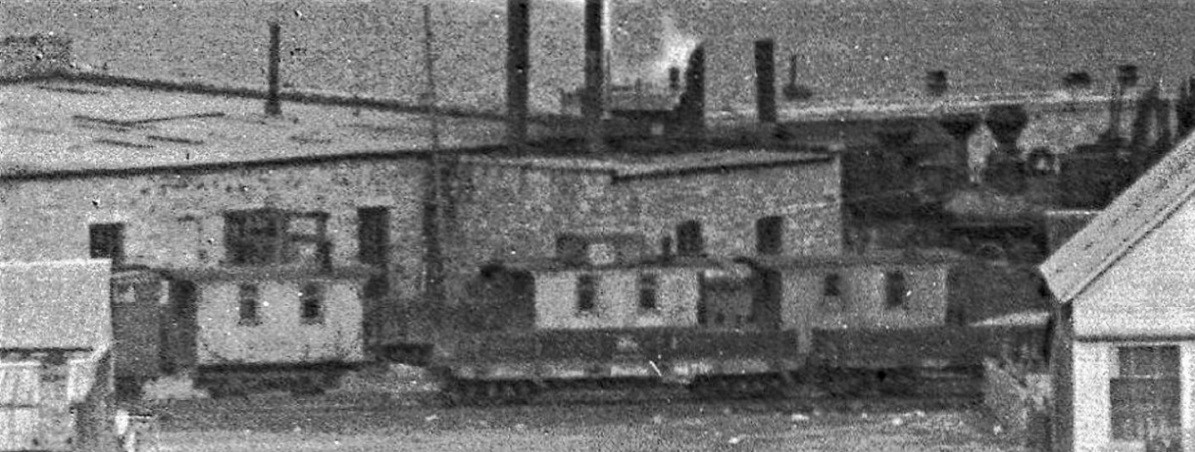
And some more:
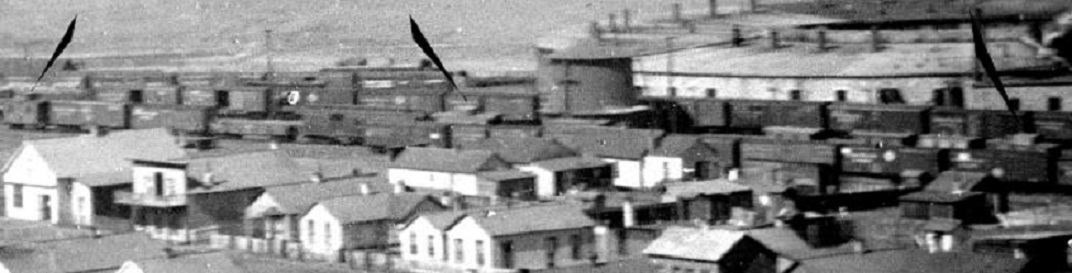
Cropped photo from Todd Hackett collection, posted by Derrell Poole in "Eight Wheel Caboose . . ." thread.
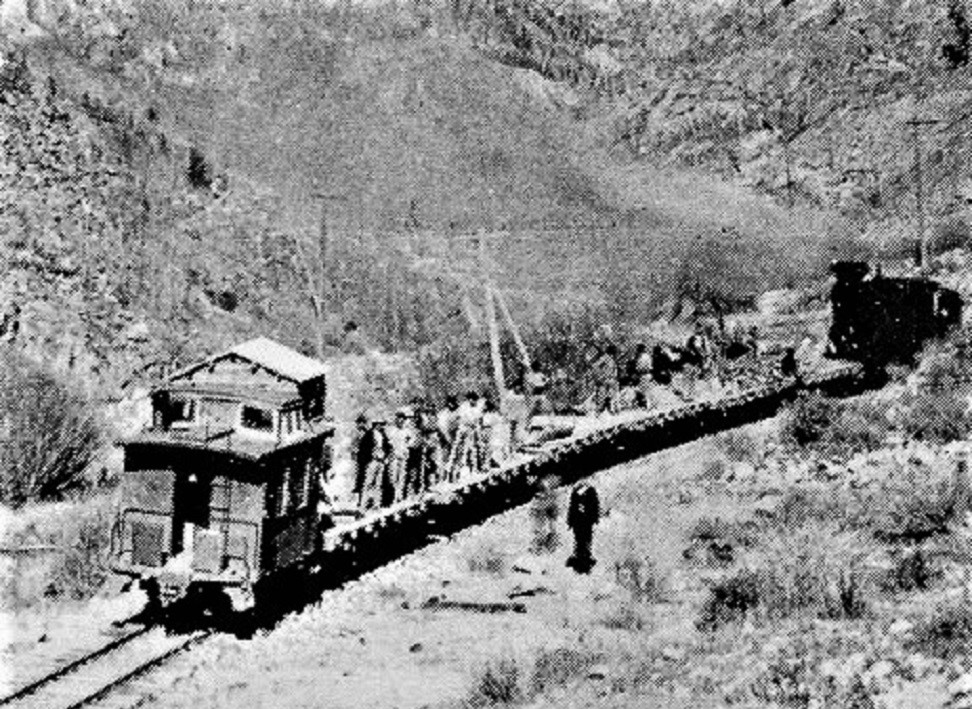
In Kindig et al, The Pictorial Supplement . . .
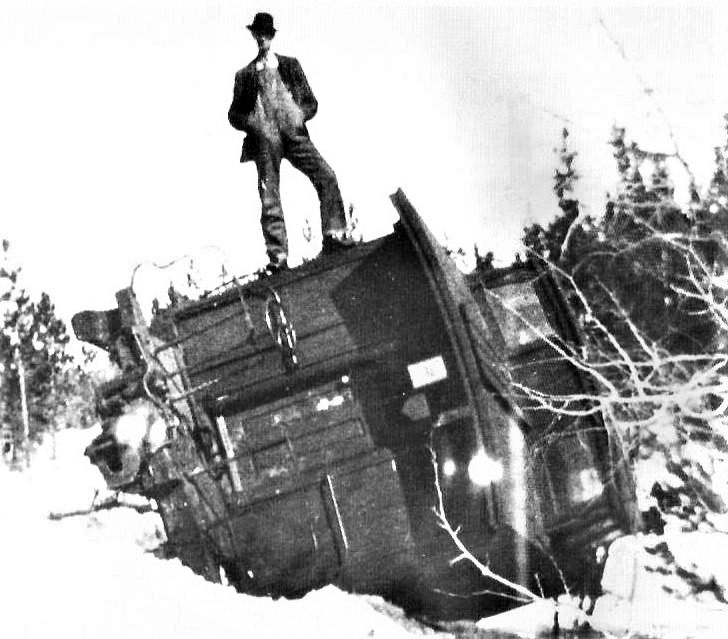
In Grandts Narrow Gauge Pictorial VIII
And of course 306:
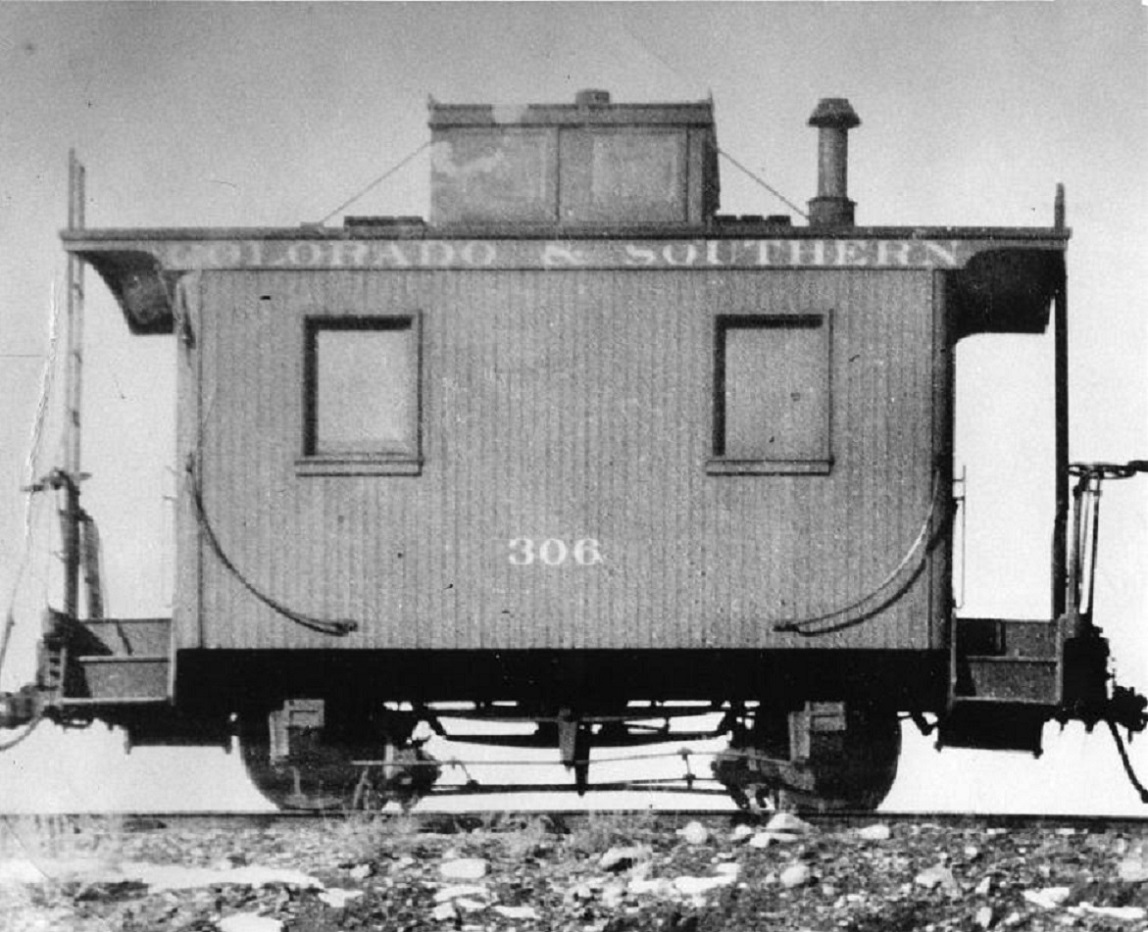
Derrell opined that the Utah & Northern 1601, the South Park car that went to Utah and then returned, may have had a center cupola added in Utah. Its return to the DL&G may have inspired the addition of cupolas to other cars. Records indicate that 303 (discussed above), 306 and 311 (wrecked in 2-1909) all had "lookouts". The Farmer brothers, in their Denver NNGC clinic, showed photos of the restoration of 310/1008, which clearly demonstrate the notches in the upper side framing members where a center cupola was once attached. So at least 4 cars had center cupolas added during rebuilding in the 1890s. It is not unreasonable to assume that the longer 9' wheel base undercarriage might have been applied to 310 and 311 as well.
4. Other evidence of rebuilding and shopping in the 1890s includes: The June 1898 DL&G Annual Report, per Derrell Poole, the first Annual Report for the South Park division after 1893. In this Report the railroad listed 12 cabooses - with Westinghouse Air Brakes. Two of them were also equipped with Selden Couplers.
__________________________
I really don't know what to make of the caboose Folios. Remember, there was not a separate caboose folio drawing set, they were a part of C&S Freight Car Folio 27. The folio drawings are not dated. The caboose sheets show both old and new numbers, implying that they were at least up dated in 1911-1912. Folio 27 also includes sheets for the SUF boxcars and stock cars of 1909 and 1910. The folios were not static things, frozen in time at creation; they were amended over the years, some cars struck, others may have been added or amended.
Derrell Poole opined that they were probably put together early in the C&S, say 1899-1901, explaining the drawings of un-rebuilt cabooses, with those short wheelbase underframes of yours. Those particular sheets could have been traced from even earlier UP or DL&G folio pages.
If so, that would suggest that 308/1006 had a 9 foot underframe with a cupola-less body in its early years on the C&S. To me, this suggests it may well have had a 9' underframe like that of 306, and was part of a subset of rebuilt cars of the 1890s. Just my opinion, can't prove it.
Could 308/1006 have acquired a new "modern" underframe later in the first decade, then have had its body rebuilt a couple of years later, thus explaining the folio drawing of a cupola-less caboose with a 9' wheel base? Yes, I guess its possible. But the plans for the modern underframe with cast journals/pedestals date to the 1908 caboose drawings:
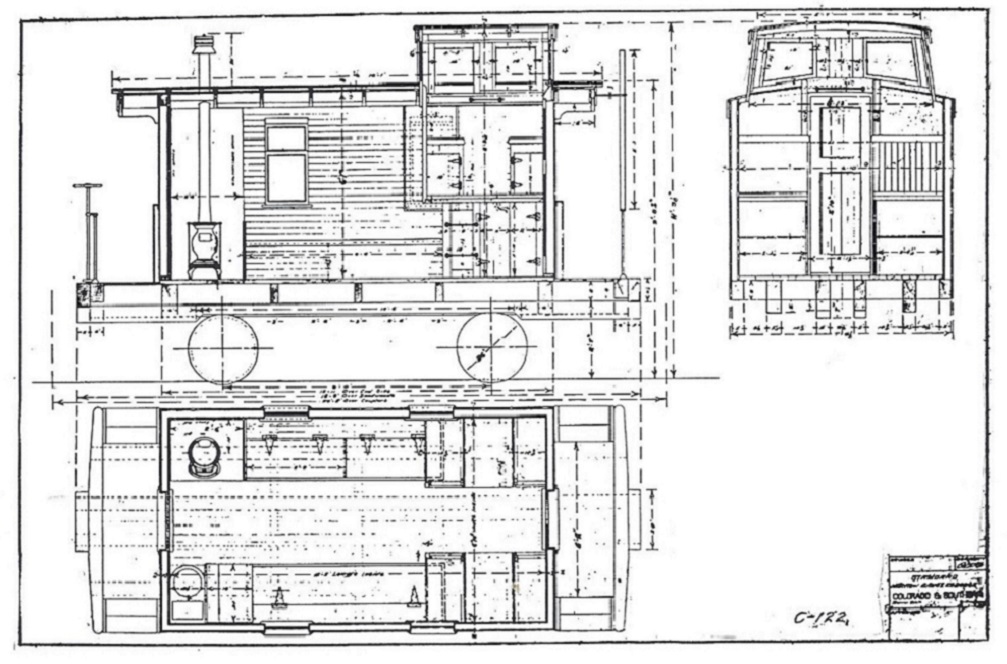
Derrel Poole quotes Hol Wagner as saying these plans were drawn for new narrow gauge caboose construction. No new cabooses were ever built, but the features of the drawings were used in the rebuilding program of 1908-1912. I find it hard to believe that caboose 308/1006 had a new underframe applied in 1908, then returned to the shops a year or two later to have rebuilding of the body. Just doesn't make sense to me.
______________
Anyways, these are my current beliefs, as I struggle to re-order my C&S caboose world:
1. You are correct, that all 20 of the waycars built by/for the DSP&P likely had underframes like that of 313, with a short wheel base of 6' 3-4". There are simply too many photos that suggest that.
2. I believe at least a few of these cars were rebuilt, along with 306, with the 9' wheelbase equalized underframe. I think the cars that acquired center cupolas in the 1890's were good candidates for that underframe; my interpretation of the folio drawing of 308/1006 suggest to me that it also received that hardware.
URL: http://c-sng-discussion-forum.254.s1.nabble.com/the-caboose-that-never-was-tp8369p10455.html
Welcome aboard this train again, even if it is headed for the asylum! Sure feels that way.
John, most of what is posted in my past two entries is heavy in speculation, short on facts. As I said, this is just my personal opinion of the C&S early caboose at this point in time.
We also have all those references, drawings and models of the early waycars with the equalized 9' undercarriage. Here's my first and most important question: Where did these all come from? Are they really all the result of looking at the single, clear 306 photo and just assuming that all the cars were built with this undercarriage? At present I don't think I have seen any contemporary (original to the early period) source for this information, it's all modern stuff, from long after the cars were rebuilt . . . Is this right? Seems to me that this is the basic question we need to answer clearly.
Yes, I believe so. The early C&S railfan draftsmen, when they set about to make drawings of the early DSP&P waycars, had a variety of clear photos of the waycar bodies and ends to measure and derive drawings. We've looked at all these photos on this thread: None have a clear view of the underframe. Then there was the photo of 306, a straight on, right angle photo with good underframe detail. This must have been the original underframe they thought, it looks similar to the D&RG 4-wheel underframes of the period. The wheelbase derived from the photo scaled out to about 9 feet, just like that on the modern, post 1908-12 rebuilt cars, so all seemed consistent. That has been the conventional wisdom since Mac Poor's famous book.
The annoying photo of 313 at Blackhawk didn't fit the conventional wisdom. Since it had an odd, different underframe and an obvious air brake cylinder/reservoir attached, the notion that the original underframe required modification for fitting of air brakes was created, to explain the anomaly. I remember reading this explanation some 40 years ago.
And so all of us lived contented lives, secure in our conventional wisdom that there were only two types of C&S caboose underframes, the original underframe like that of 306 and the modern underframe as on the surviving cabooses, both with a 9 foot wheel base.
Then along comes John Greenly who thinks, "wow, the underframe of 313 looks awfully short". He then proceeds to apply scientific method, using a perspective algorithm, and comes up with a wheel base of only 6' 3-4". Kinda like Galileo pointing out the obvious, that the earth likely wasn't the center of the universe.
Yours truly remembers a folio sheet, showing a short wheel base undercarriage under an un-rebuilt caboose, that he never understood. He posts it.
Then we start looking at a lot of different photos. We begin to think, "Whoa, ya know, all of those early waycars do seem to have awfully short wheelbase underframes!" Conventional wisdom is shattered, chaos descends, I no longer know what to believe . . .
I agree, the only factual information we have are two photos and three folio sheets (with inconsistencies / contradictions) of unknown date. There is also some historic documentation gathered by Derrell Poole, that I have teased out of Derrell's classic thread: http://c-sng-discussion-forum.41377.n7.nabble.com/Eight-wheel-Caboose-on-C-amp-Sng-td488.html
Let's ignore the two C&S cabooses that came from the CC/UPD&G (I don't understand them enough to discuss them).
Derrell makes a convincing case that of the 12 cabooses inherited by the C&S from the DL&G at the end of 1898, all were originally South Park built cars. His summary (details of his thinking in the thread):
Summary:
1) Four DSP&P waycars go to Ogden and become U&N 1600 - 1604.
2) One car, 1601, returns to Denver for the UPD&G.
3) The car sees more service and use on the DL&G.
4) The Gulf passed "ownership" of 1601 to the DL&G (joining 11 surviving South Park waycars, a total of 12 cars passed on to the new C&S)
There were no TRUE foreign (non Colorado) cabooses on the C&Sng.
If you except this premise, that all the DL&G cabooses inherited by the new C&S were originally South Park cars, then rebuilding of a subset of the cars must have happened in the 1890s:
1. Caboose 306 arrived on the C&S with a center cupola and the spidery, equalized, 9 foot wheelbase undercarriage. The car must have been rebuilt sometime prior to arrival on the C&S. When? Late 1880s? 1890s? Where, Colorado? Or if this was former UN 1601, in Utah?
2. Derrell points out that "It is interesting to note that in a 1903 roster all of the former South Park cars were nearly identical in size - inside dimensions - (average 12'-5" length) except 303. (Three cars were listed without dimensions). 303 was at least 2 feet longer than any of the other cars. The dimensions are Pre - C&S rebuild (standard) of 1908."
If 303 was one of the original South Park cars, how did it get stretched out in length by 2 feet and obtain a cupola to boot? It is hard to "rebuild" a caboose and end up with a car 2 feet longer. Under frame sills and longitudinal framing members don't stretch. This car was likely a new build in the 1890s, to replace a wrecked, vacated car, and assigned the same number. Derrell suggests that as a possibility. I believe this car rode on a pair of 20 ton swing beam trucks well into the 19teens.
3. Application of cupolas: Photos of way cars with center cupolas begin showing up in the 1890's as well as the early C&S years. Remember the un-cropped image by Dr Scott:
And some more:
Cropped photo from Todd Hackett collection, posted by Derrell Poole in "Eight Wheel Caboose . . ." thread.
In Kindig et al, The Pictorial Supplement . . .
In Grandts Narrow Gauge Pictorial VIII
And of course 306:
Derrell opined that the Utah & Northern 1601, the South Park car that went to Utah and then returned, may have had a center cupola added in Utah. Its return to the DL&G may have inspired the addition of cupolas to other cars. Records indicate that 303 (discussed above), 306 and 311 (wrecked in 2-1909) all had "lookouts". The Farmer brothers, in their Denver NNGC clinic, showed photos of the restoration of 310/1008, which clearly demonstrate the notches in the upper side framing members where a center cupola was once attached. So at least 4 cars had center cupolas added during rebuilding in the 1890s. It is not unreasonable to assume that the longer 9' wheel base undercarriage might have been applied to 310 and 311 as well.
4. Other evidence of rebuilding and shopping in the 1890s includes: The June 1898 DL&G Annual Report, per Derrell Poole, the first Annual Report for the South Park division after 1893. In this Report the railroad listed 12 cabooses - with Westinghouse Air Brakes. Two of them were also equipped with Selden Couplers.
__________________________
I really don't know what to make of the caboose Folios. Remember, there was not a separate caboose folio drawing set, they were a part of C&S Freight Car Folio 27. The folio drawings are not dated. The caboose sheets show both old and new numbers, implying that they were at least up dated in 1911-1912. Folio 27 also includes sheets for the SUF boxcars and stock cars of 1909 and 1910. The folios were not static things, frozen in time at creation; they were amended over the years, some cars struck, others may have been added or amended.
Derrell Poole opined that they were probably put together early in the C&S, say 1899-1901, explaining the drawings of un-rebuilt cabooses, with those short wheelbase underframes of yours. Those particular sheets could have been traced from even earlier UP or DL&G folio pages.
If so, that would suggest that 308/1006 had a 9 foot underframe with a cupola-less body in its early years on the C&S. To me, this suggests it may well have had a 9' underframe like that of 306, and was part of a subset of rebuilt cars of the 1890s. Just my opinion, can't prove it.
Could 308/1006 have acquired a new "modern" underframe later in the first decade, then have had its body rebuilt a couple of years later, thus explaining the folio drawing of a cupola-less caboose with a 9' wheel base? Yes, I guess its possible. But the plans for the modern underframe with cast journals/pedestals date to the 1908 caboose drawings:
Derrel Poole quotes Hol Wagner as saying these plans were drawn for new narrow gauge caboose construction. No new cabooses were ever built, but the features of the drawings were used in the rebuilding program of 1908-1912. I find it hard to believe that caboose 308/1006 had a new underframe applied in 1908, then returned to the shops a year or two later to have rebuilding of the body. Just doesn't make sense to me.
______________
Anyways, these are my current beliefs, as I struggle to re-order my C&S caboose world:
1. You are correct, that all 20 of the waycars built by/for the DSP&P likely had underframes like that of 313, with a short wheel base of 6' 3-4". There are simply too many photos that suggest that.
2. I believe at least a few of these cars were rebuilt, along with 306, with the 9' wheelbase equalized underframe. I think the cars that acquired center cupolas in the 1890's were good candidates for that underframe; my interpretation of the folio drawing of 308/1006 suggest to me that it also received that hardware.
Jim Courtney
Poulsbo, WA
Poulsbo, WA
| Free forum by Nabble | Edit this page |