Re: C&S caboose undercarriage yet again
Posted by Jim Courtney on
URL: http://c-sng-discussion-forum.254.s1.nabble.com/the-caboose-that-never-was-tp8369p10445.html
Well, well, John,
It looks like you and I have been doing the same thing during our 3 month hiatus of discussion -- trying to make sense of the early South Park / C&S waycar underframes.
I hope you did not think me rude, when I dropped out of the discussion at the end of September. I simply did not know what more to say, because I no longer knew what to think! There is simply too much inconsistent, contradictory or complete lack of information to draw firm conclusions about the caboose underframes prior to the 1908-1912 rebuilding. I've spent the past 3 months re-reading the "authorities" on this subject and spending far too much time staring at my caboose photos.
All that the available documentation proves is that the original South Park and Central cabooses, that survived to the modern era, were rebuilt 1908-1912 with cast pedestal journals, attached to deep intermediate beams, with a wheel base of 9 feet and inside hung brake beams. The exception was 1002 which continued to ride on a pair of 4 foot wheel base freight car trucks well into the mid teens.
Prior to the rebuilding, the evidence boils down to two competing photos: The c1900 view of the 306/1005, with the familiar 9 foot outside equalized underframe, vs the Blackhawk view of 313 (about 1910) with that odd, poorly defined undercarriage with a short wheel base, based on your perspective algorithm estimates to be about 6'-3" give or take an inch.
So, which is the norm and which is the anomaly? Or are they both anomalies?
But, on the other hand, what if they are both norms?
So here is where my thinking sits at the moment:
All of the original South Park cabooses (don't know about the Central cars) were built with the odd, short wheel base underframes, as on number 313 at Blackhawk. Most continued to ride on this odd underframe until rebuilt c1908-1912 or were scrapped.
A subset of the original cars underwent rebuilding, sometime between 1890-1898, either under UP ownership or slightly later during the Trumbull receivership. Some cars may have been demolished in wrecks and a completely new car built to occupy the vacated number. These rebuilds/new builds of the 1890s received a new 9' wheel base underframe, like on 306/1005. I suspect 308/1006 was another such car that received the 9' wheel base underframe. The number of cabooses in this subset is unknown.
To me, the only written documentation that sheds light on the pre-1908 underframes are the surviving folio drawings from Folio 27, dated about 1911 (due to the modern caboose numbers). I had forgotten about John Maxwell's tracing of the folio drawing of C&S 309/1007. It is not clear whether Maxwell traced another Folio 27 drawing, or whether it came from another, earlier folio set (Maxwell's drawing of rebuilt 1007 differs from the Folio 27 drawing of 1007).
I bought my copy of Maxwell's drawing almost 40 years ago. Let's put up all three folios up for 304, 308, 309:
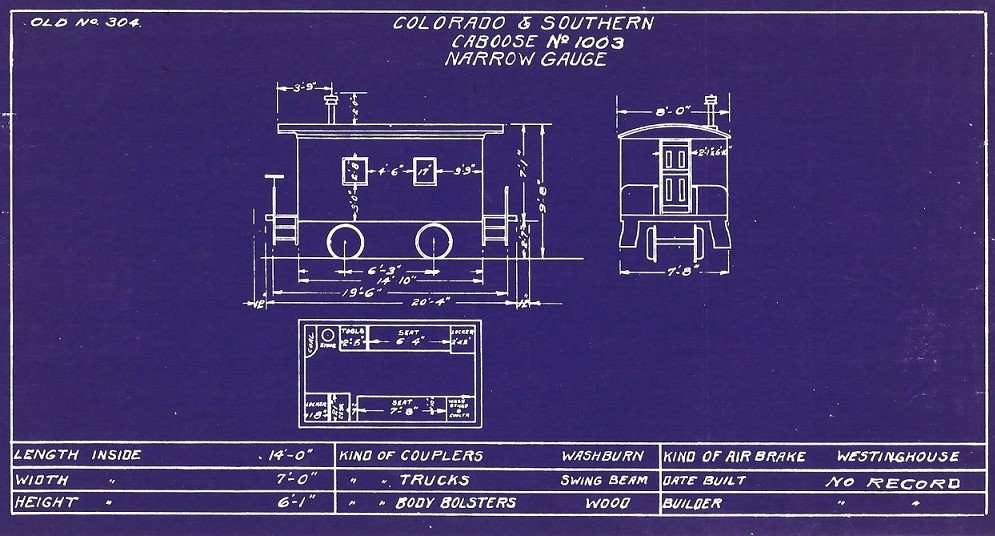
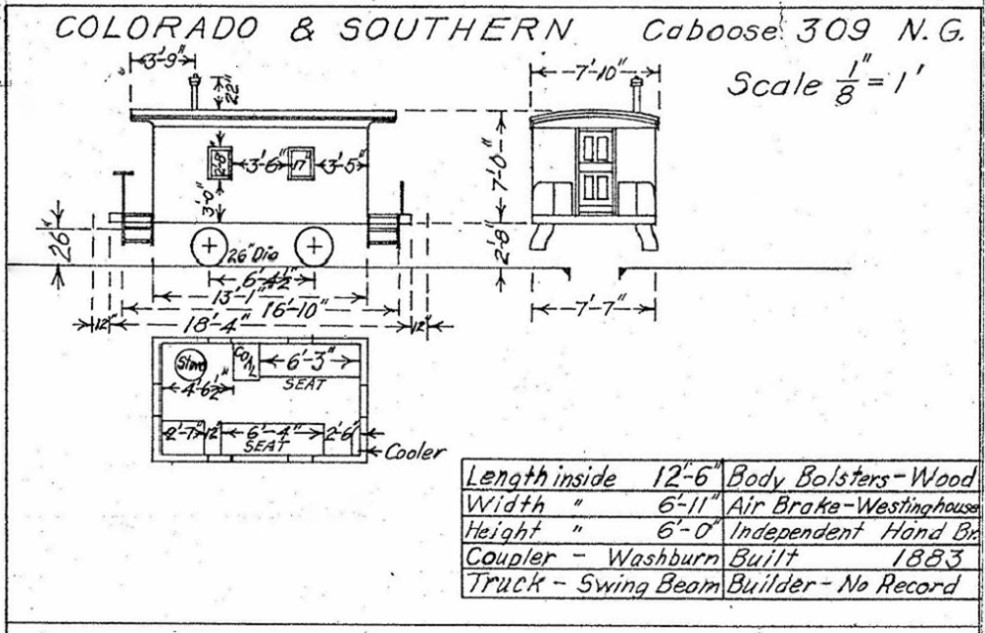

These three folio drawing are full of contradictions as well.
Derrel Poole, in the "Eight Wheel Caboose . . ." thread, pointed out that the purpose of a folio drawing was to convey written information as to dimensions, weight, construction components, etc. The image was never to be taken as a detailed drawing. Sometimes the same image would be used for several similar but slightly different pieces of equipment. (This was particularly true of the early C&S locomotive folios, as all the wagon-top boilered 2-8-0 folios used the same image).
If a car was modified in some way, the image would be retraced from an earlier folio, and the changes in dimensions would be inked in, either on the image or in the table below.
The folio images for 304 and 309 look identical to me, other than the interior floor plan. I suspect that they were traced from the first image drawn for the first caboose folio: Since the title of this folio collection was "Folio 27", that implies that there were 26 prior editions. I see no way that the C&S, from its late 1898 creation to 1911, could have possibly issued 27 different freight car folio sets. I suspect that "Folio Number 1", was drawn up by UP draftsmen, probably in 1885, when the freight cars were all renumbered, to integrate all the subsidiary roads into the UP proper. This original folio set was updated periodically (annually?) by the UP, passed on to the DL&G and inherited and continued by the C&S.
This may be complete B.S, but if "Folio No. 1" was drawn in 1885 and was re-issued annually (with updates of individual folio sheets as required) then 1885 + 26 new folio sets would take us to the year 1911, the same year that the caboose renumbering scheme was devised (cue Twilight Zone music).
Is that why the folio sheets carry both the old and new numbers? Since there are Folio 27 drawings for both 309 and rebuilt 1007, the same car, does that mean that 1007 was rebuilt to the modern configuration in 1911? And since neither 304/1003 nor 308/1006 have been redrawn with the end cupola, does that mean that they have not yet been rebuilt in 1911?
And what about the drawing of 308/1006. The image is clearly different from the other folio images, no mention of John's swing beam truck or wood bolster; and this image clearly has the wheels drawn to reflect a longer 9'-0" wheel base underframe. Suppose that the DL&G predecessor of 308 was a 1895 rebuild/new build and acquired the 9' wheel base underframe (like that of the 306 photo) in the process--did a draftsman create a new drawing for a folio sheet for the "Folio 11" issue to reflect a new and different car from the other cabooses?
This early C&S caboose stuff can be maddening in all the uncertainties, but if this Forum can keep up the discussion, perhaps we can collectively develop a "Unified Theory of the C&S Caboose", one that incorporates and explains all the contradictions.
URL: http://c-sng-discussion-forum.254.s1.nabble.com/the-caboose-that-never-was-tp8369p10445.html
Well, well, John,
It looks like you and I have been doing the same thing during our 3 month hiatus of discussion -- trying to make sense of the early South Park / C&S waycar underframes.
I hope you did not think me rude, when I dropped out of the discussion at the end of September. I simply did not know what more to say, because I no longer knew what to think! There is simply too much inconsistent, contradictory or complete lack of information to draw firm conclusions about the caboose underframes prior to the 1908-1912 rebuilding. I've spent the past 3 months re-reading the "authorities" on this subject and spending far too much time staring at my caboose photos.
All that the available documentation proves is that the original South Park and Central cabooses, that survived to the modern era, were rebuilt 1908-1912 with cast pedestal journals, attached to deep intermediate beams, with a wheel base of 9 feet and inside hung brake beams. The exception was 1002 which continued to ride on a pair of 4 foot wheel base freight car trucks well into the mid teens.
Prior to the rebuilding, the evidence boils down to two competing photos: The c1900 view of the 306/1005, with the familiar 9 foot outside equalized underframe, vs the Blackhawk view of 313 (about 1910) with that odd, poorly defined undercarriage with a short wheel base, based on your perspective algorithm estimates to be about 6'-3" give or take an inch.
So, which is the norm and which is the anomaly? Or are they both anomalies?
But, on the other hand, what if they are both norms?
So here is where my thinking sits at the moment:
All of the original South Park cabooses (don't know about the Central cars) were built with the odd, short wheel base underframes, as on number 313 at Blackhawk. Most continued to ride on this odd underframe until rebuilt c1908-1912 or were scrapped.
A subset of the original cars underwent rebuilding, sometime between 1890-1898, either under UP ownership or slightly later during the Trumbull receivership. Some cars may have been demolished in wrecks and a completely new car built to occupy the vacated number. These rebuilds/new builds of the 1890s received a new 9' wheel base underframe, like on 306/1005. I suspect 308/1006 was another such car that received the 9' wheel base underframe. The number of cabooses in this subset is unknown.
To me, the only written documentation that sheds light on the pre-1908 underframes are the surviving folio drawings from Folio 27, dated about 1911 (due to the modern caboose numbers). I had forgotten about John Maxwell's tracing of the folio drawing of C&S 309/1007. It is not clear whether Maxwell traced another Folio 27 drawing, or whether it came from another, earlier folio set (Maxwell's drawing of rebuilt 1007 differs from the Folio 27 drawing of 1007).
I bought my copy of Maxwell's drawing almost 40 years ago. Let's put up all three folios up for 304, 308, 309:
These three folio drawing are full of contradictions as well.
Derrel Poole, in the "Eight Wheel Caboose . . ." thread, pointed out that the purpose of a folio drawing was to convey written information as to dimensions, weight, construction components, etc. The image was never to be taken as a detailed drawing. Sometimes the same image would be used for several similar but slightly different pieces of equipment. (This was particularly true of the early C&S locomotive folios, as all the wagon-top boilered 2-8-0 folios used the same image).
If a car was modified in some way, the image would be retraced from an earlier folio, and the changes in dimensions would be inked in, either on the image or in the table below.
The folio images for 304 and 309 look identical to me, other than the interior floor plan. I suspect that they were traced from the first image drawn for the first caboose folio: Since the title of this folio collection was "Folio 27", that implies that there were 26 prior editions. I see no way that the C&S, from its late 1898 creation to 1911, could have possibly issued 27 different freight car folio sets. I suspect that "Folio Number 1", was drawn up by UP draftsmen, probably in 1885, when the freight cars were all renumbered, to integrate all the subsidiary roads into the UP proper. This original folio set was updated periodically (annually?) by the UP, passed on to the DL&G and inherited and continued by the C&S.
This may be complete B.S, but if "Folio No. 1" was drawn in 1885 and was re-issued annually (with updates of individual folio sheets as required) then 1885 + 26 new folio sets would take us to the year 1911, the same year that the caboose renumbering scheme was devised (cue Twilight Zone music).
Is that why the folio sheets carry both the old and new numbers? Since there are Folio 27 drawings for both 309 and rebuilt 1007, the same car, does that mean that 1007 was rebuilt to the modern configuration in 1911? And since neither 304/1003 nor 308/1006 have been redrawn with the end cupola, does that mean that they have not yet been rebuilt in 1911?
And what about the drawing of 308/1006. The image is clearly different from the other folio images, no mention of John's swing beam truck or wood bolster; and this image clearly has the wheels drawn to reflect a longer 9'-0" wheel base underframe. Suppose that the DL&G predecessor of 308 was a 1895 rebuild/new build and acquired the 9' wheel base underframe (like that of the 306 photo) in the process--did a draftsman create a new drawing for a folio sheet for the "Folio 11" issue to reflect a new and different car from the other cabooses?
This early C&S caboose stuff can be maddening in all the uncertainties, but if this Forum can keep up the discussion, perhaps we can collectively develop a "Unified Theory of the C&S Caboose", one that incorporates and explains all the contradictions.
Jim Courtney
Poulsbo, WA
Poulsbo, WA
| Free forum by Nabble | Edit this page |