C&S caboose undercarriage yet again
Posted by John Greenly on
URL: http://c-sng-discussion-forum.254.s1.nabble.com/the-caboose-that-never-was-tp8369p10442.html
Well, okay. I've taken a long break from the caboose undercarriage woes, but came back to it in the last couple of weeks, and I have a few things to add: a couple of scant facts, a review of my earlier measurements, and, of course, some new speculation.
First of all, after returning to this and checking everything over again, I believe I still agree with my conclusions about the photos we have on this thread, with one exception.
The caboose on the bridge in the snowy Georgetown photo cannot be an eight-wheeler, there just isn't anywhere near enough length under there unless the trucks have internal brake shoes and about 3' wheelbase. Just compare the length under the caboose with a truck on the boxcars ahead of it and you can see the problem. I don't know what's under there, but I'll bet it's four wheels on a long wheelbase (a CC car) and maybe some other stuff hung down there.
Otherwise, I believe all the photos are, as I remarked at the time, either impossible to measure or consistent with the short wheelbase, except for the CC caboose at Beaver Brook, which probably has a long wheelbase. (short = 6'3" or so, long = 9')
Now here's a new piece of factual information, for me at least. Crain's railway pages have a set of Maxwell drawings, including a pair of 309/1007:
http://www.ross-crain.com/rr_dsp6b-maxwell.htm
I wouldn't reproduce them here in respect of Maxwell's possible copyright, but they certainly have been posted there for a long time, so here they are for convenience-- I will delete them if you think I shouldn't reproduce them here.
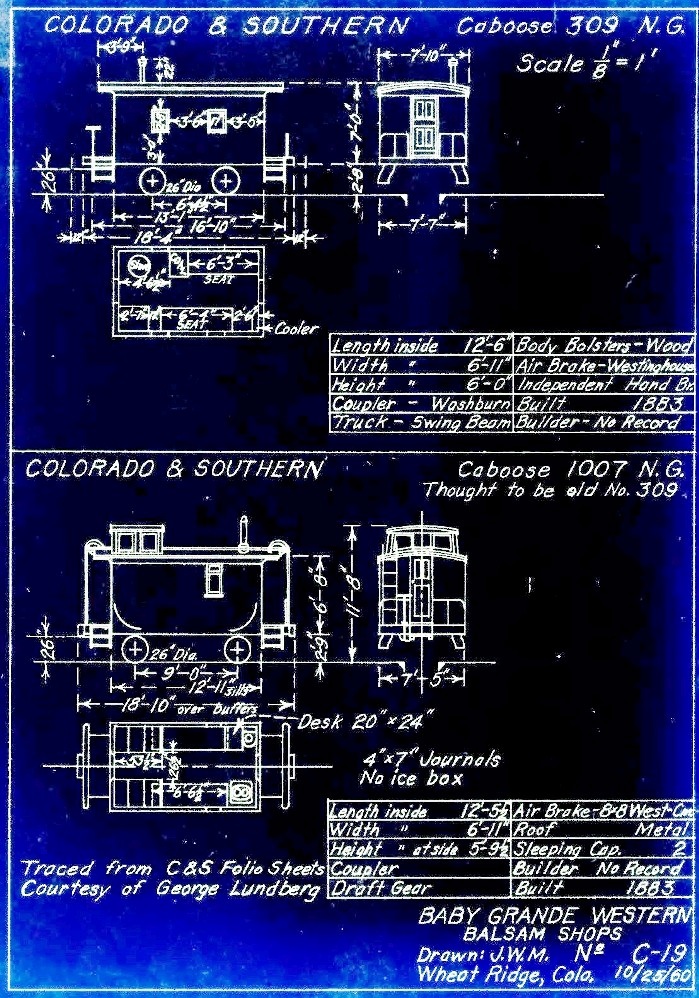
So, here is a second case to go along with the folio of 304/1003 that Jim put up here.
As you see, the wheelbase of 309 is shown as 6' 4 1/2". Our 304 folio 6' 3" wheelbase now has a very near-twin. To me especially fascinating is the inscription, identical on both 309 and 304: Truck: swing beam, bolster: wood.
What can this possibly mean??? Now I'm off into speculation again. I'm inclining more strongly, lacking any contemporary (photos or drawings) information to the contrary, to the idea that this short wheelbase undercarriage, whatever it was, was the original on most or all of the DSP&P waycars. And I'm more and more inclined to the idea that it was in fact a "truck" of some sort. I've been puzzling for so long now over the 313 Blackhawk photo, here it is with enhanced contrast as best I can make it:
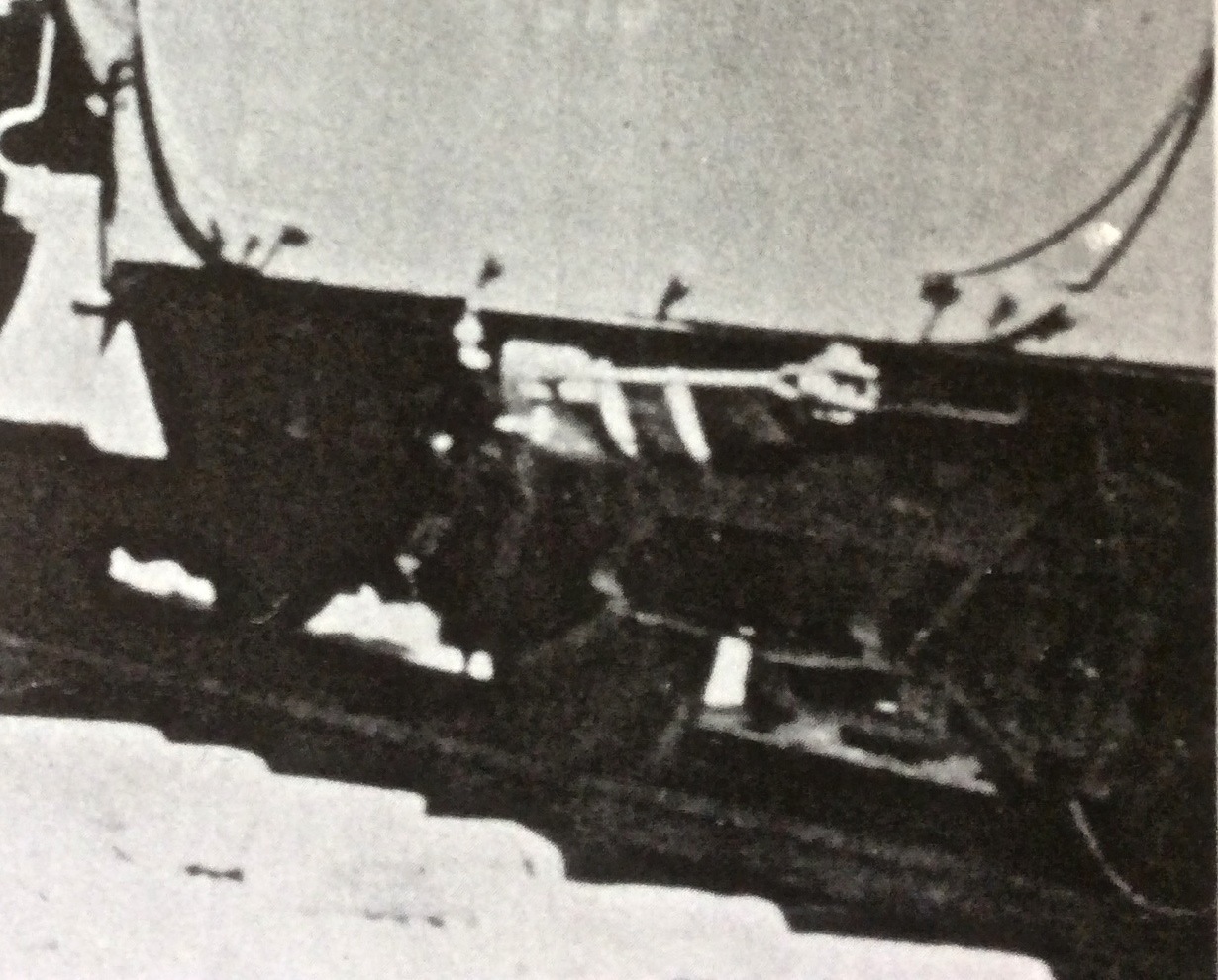
Chris's post on this thread of a Uintah caboose clearly shows that it sat, at least for some time, on a single swing beam or archbar freight truck. This truck did not have individually sprung journals in pedestals, but like a swing beam truck, had its springing in the bolster. What a weird thing to use singly under a car! It's very easy to imagine how the name "bobber" came, if you think for a moment about the freedom to pitch in the fore-and-aft direction that this suspension would allow. A fine idea when there are two of them at the ends of a car, a crazy idea for a single undercarriage. From the 313 photo, (and the Como photo as well, small and grainy as it is), it is certain that the beam that carries the journals is well below the bottom of the car side and much lower than the deep sill that carries the pedestals on the modern 9' undercarriage. Here's the Como photo again, for reference:
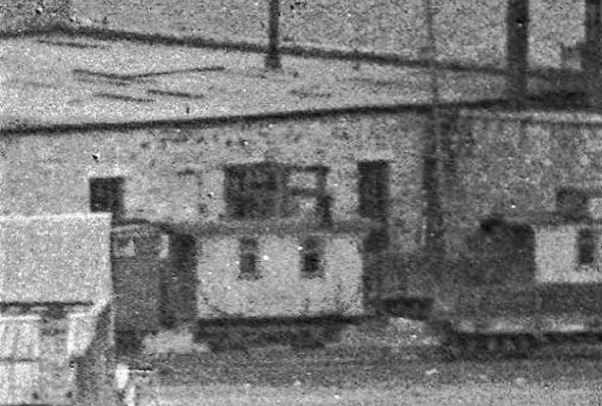
I don't know whether there is enough vertical space between the journals and this low beam for springs above the journals on these cars. I doubt it. Thus the "truck" may be either rigid, or else there is some sort of springing between the beam and the car body. The written description on the folio sheets is "swing beam" truck. Maybe, crazy as it seems, that's actually what it is. I've been studying the early history of trucks, more on that later perhaps, and I'd dearly love to have some expert on early wood-beam trucks out there weigh in on this. Here's an example of a passenger truck on the very first Pullman car (1858, standard gauge):
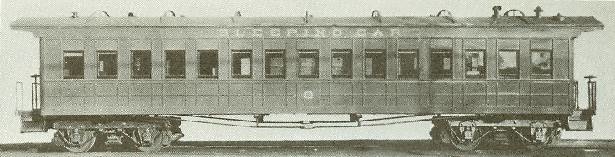
This car does have individual journal springs (coil or possibly rubber), but also has a swing-beam bolster. These bolsters commonly used transverse leaf springs, which ride better than coils because the friction between the flexing leaves does a better job of damping out bouncing. It could be that the 313 photo shows leaf spring mounting brackets: the bright objects that project outward just below the beam that the skinny reinforcing rods are attached to, and are about 2 1/2 feet apart. Then the bolster of course doesn't have rotational mounting and is fixed to the sills, while the longitudinal beam carrying the journals is part of the unsprung weight.
A second possibility also involves leaf springs and I like it maybe better, though it occurred to me more recently and I haven't had as long to develop doubt. It is that those projections are indeed leaf spring mounts, but the springs are longitudinal, underslung and passing beneath the pedestals with a link connecting up to the journals. Thus the journals would be individually sprung and the beam would be fixed to the car body, a very sensible arrangement, if four wheels on such a short wheelbase are ever sensible. I found this underslung leaf-sprung journal arrangement described in an 1892 book on truck evolution that I am reading, I will post a diagram later. This, however, would not be described as a "swing beam" truck, as far as I can make out at present, so it leaves a mystery of the description in the folios. You might also ask, if it was done this way, then why not just make the wheelbase longer in the first place? A possible explanation is that trucks underwent a gradual evolution from short to longer wheelbase through most of the nineteenth century, gradually overcoming a belief that long wheelbase would lead to excessive wear because of the increased misalignment of the wheel and rail on curves. In the early 1880's wheelbases longer than 6' were rare, and on the narrow gauge, only the Pullman cars had wheelbases longer than 5', I believe. This is actually I believe quite a strong argument against a 9' wheelbase having been applied to these waycars in the early 1880's.
Other points: the deeper intermediate sill that carries the pedestals on the modern undercarriage is visible below the end sill. In none of the photos can I find evidence of this deep sill. I believe it must have been added when the cars were rebuilt, to carry the modern undercarriage pedestals. The brake rigging definitely passes from the cylinder above the truck beam on the short undercarriage, barely beneath the car side and probably too high to clear a deeper sill. So far I can't convince myself whether the truck had outside or inside brakes. The 313 photo seems to show none on the inside of the lefthand wheel, and a couple of the other photos seem to me to hint at outside brake beams, but I'm not sure.
I'm beginning to think in a feverish way of building a model with the short wheelbase, all the details will be totally speculative of course, but it would be fun to see what it looks like with the wheels so close together, and to find out whether it would stay on the rails at all. And it would serve a genuine purpose. I could use it, along with the long-wheelbase version, to compare in perspective with all the photographs, to check yet again my conclusions, in the most direct possible way.
So, I've clearly gone way off the deep end, but there's some strange comfort in sharing my ravings with you all.
????
John
URL: http://c-sng-discussion-forum.254.s1.nabble.com/the-caboose-that-never-was-tp8369p10442.html
Well, okay. I've taken a long break from the caboose undercarriage woes, but came back to it in the last couple of weeks, and I have a few things to add: a couple of scant facts, a review of my earlier measurements, and, of course, some new speculation.
First of all, after returning to this and checking everything over again, I believe I still agree with my conclusions about the photos we have on this thread, with one exception.
The caboose on the bridge in the snowy Georgetown photo cannot be an eight-wheeler, there just isn't anywhere near enough length under there unless the trucks have internal brake shoes and about 3' wheelbase. Just compare the length under the caboose with a truck on the boxcars ahead of it and you can see the problem. I don't know what's under there, but I'll bet it's four wheels on a long wheelbase (a CC car) and maybe some other stuff hung down there.
Otherwise, I believe all the photos are, as I remarked at the time, either impossible to measure or consistent with the short wheelbase, except for the CC caboose at Beaver Brook, which probably has a long wheelbase. (short = 6'3" or so, long = 9')
Now here's a new piece of factual information, for me at least. Crain's railway pages have a set of Maxwell drawings, including a pair of 309/1007:
http://www.ross-crain.com/rr_dsp6b-maxwell.htm
I wouldn't reproduce them here in respect of Maxwell's possible copyright, but they certainly have been posted there for a long time, so here they are for convenience-- I will delete them if you think I shouldn't reproduce them here.
So, here is a second case to go along with the folio of 304/1003 that Jim put up here.
As you see, the wheelbase of 309 is shown as 6' 4 1/2". Our 304 folio 6' 3" wheelbase now has a very near-twin. To me especially fascinating is the inscription, identical on both 309 and 304: Truck: swing beam, bolster: wood.
What can this possibly mean??? Now I'm off into speculation again. I'm inclining more strongly, lacking any contemporary (photos or drawings) information to the contrary, to the idea that this short wheelbase undercarriage, whatever it was, was the original on most or all of the DSP&P waycars. And I'm more and more inclined to the idea that it was in fact a "truck" of some sort. I've been puzzling for so long now over the 313 Blackhawk photo, here it is with enhanced contrast as best I can make it:
Chris's post on this thread of a Uintah caboose clearly shows that it sat, at least for some time, on a single swing beam or archbar freight truck. This truck did not have individually sprung journals in pedestals, but like a swing beam truck, had its springing in the bolster. What a weird thing to use singly under a car! It's very easy to imagine how the name "bobber" came, if you think for a moment about the freedom to pitch in the fore-and-aft direction that this suspension would allow. A fine idea when there are two of them at the ends of a car, a crazy idea for a single undercarriage. From the 313 photo, (and the Como photo as well, small and grainy as it is), it is certain that the beam that carries the journals is well below the bottom of the car side and much lower than the deep sill that carries the pedestals on the modern 9' undercarriage. Here's the Como photo again, for reference:
I don't know whether there is enough vertical space between the journals and this low beam for springs above the journals on these cars. I doubt it. Thus the "truck" may be either rigid, or else there is some sort of springing between the beam and the car body. The written description on the folio sheets is "swing beam" truck. Maybe, crazy as it seems, that's actually what it is. I've been studying the early history of trucks, more on that later perhaps, and I'd dearly love to have some expert on early wood-beam trucks out there weigh in on this. Here's an example of a passenger truck on the very first Pullman car (1858, standard gauge):
This car does have individual journal springs (coil or possibly rubber), but also has a swing-beam bolster. These bolsters commonly used transverse leaf springs, which ride better than coils because the friction between the flexing leaves does a better job of damping out bouncing. It could be that the 313 photo shows leaf spring mounting brackets: the bright objects that project outward just below the beam that the skinny reinforcing rods are attached to, and are about 2 1/2 feet apart. Then the bolster of course doesn't have rotational mounting and is fixed to the sills, while the longitudinal beam carrying the journals is part of the unsprung weight.
A second possibility also involves leaf springs and I like it maybe better, though it occurred to me more recently and I haven't had as long to develop doubt. It is that those projections are indeed leaf spring mounts, but the springs are longitudinal, underslung and passing beneath the pedestals with a link connecting up to the journals. Thus the journals would be individually sprung and the beam would be fixed to the car body, a very sensible arrangement, if four wheels on such a short wheelbase are ever sensible. I found this underslung leaf-sprung journal arrangement described in an 1892 book on truck evolution that I am reading, I will post a diagram later. This, however, would not be described as a "swing beam" truck, as far as I can make out at present, so it leaves a mystery of the description in the folios. You might also ask, if it was done this way, then why not just make the wheelbase longer in the first place? A possible explanation is that trucks underwent a gradual evolution from short to longer wheelbase through most of the nineteenth century, gradually overcoming a belief that long wheelbase would lead to excessive wear because of the increased misalignment of the wheel and rail on curves. In the early 1880's wheelbases longer than 6' were rare, and on the narrow gauge, only the Pullman cars had wheelbases longer than 5', I believe. This is actually I believe quite a strong argument against a 9' wheelbase having been applied to these waycars in the early 1880's.
Other points: the deeper intermediate sill that carries the pedestals on the modern undercarriage is visible below the end sill. In none of the photos can I find evidence of this deep sill. I believe it must have been added when the cars were rebuilt, to carry the modern undercarriage pedestals. The brake rigging definitely passes from the cylinder above the truck beam on the short undercarriage, barely beneath the car side and probably too high to clear a deeper sill. So far I can't convince myself whether the truck had outside or inside brakes. The 313 photo seems to show none on the inside of the lefthand wheel, and a couple of the other photos seem to me to hint at outside brake beams, but I'm not sure.
I'm beginning to think in a feverish way of building a model with the short wheelbase, all the details will be totally speculative of course, but it would be fun to see what it looks like with the wheels so close together, and to find out whether it would stay on the rails at all. And it would serve a genuine purpose. I could use it, along with the long-wheelbase version, to compare in perspective with all the photographs, to check yet again my conclusions, in the most direct possible way.
So, I've clearly gone way off the deep end, but there's some strange comfort in sharing my ravings with you all.
????
John
John Greenly
Lansing, NY
Lansing, NY
| Free forum by Nabble | Edit this page |