|
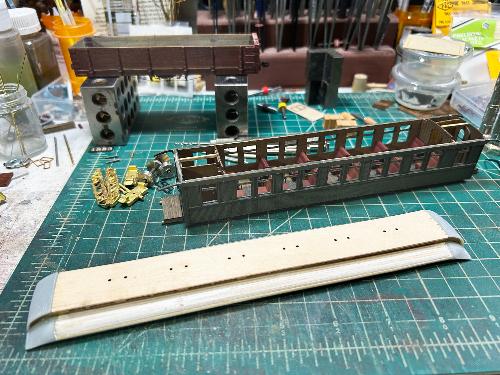
Building the Leadville Designs Sn3 U&N/UPD&G Plan 73 sleeper and will soon build the baggage car. Need to know what kind of typical C&S roofing material was used. Fun built. Challenging roof construction but doable with care. Haven't deviated too much from instructions...
![]() Thanks for any help. Mike |
|
I would think one possibility would be painted canvas. i have seen standard gauge cars of that era with this type of roof. streetcars use the same system. my former caboose, that was not retired from service until the early 1970's had a canvas roof, and i initial replaced in kind, but it needs constant maintenance in the form of applying a fresh coat of paint every year. I replaced the second time with modern rubber roof.
Al P. |
|
Mike, I am by no means an expert. There is a 2-volume set on 19th C Passenger Cars, and my set is stashed away in an undisclosed location, so I cannot tell you what it says, but maybe Google scanned these books, and you can find them online?
I am sure canvas was an early solution, and probably thoroughly coated in linseed oil, or some other water-resistant coating. Some of the roofs appear to be covered in metal, with solder--or perhaps a lap joint filled with solder--in the short direction of the cars. D&RGW cars seem to have this detail. I emulated this on my C&S RPO with weld beads from Archer. I am finishing a Ride Trains model of Baggage #4. The roof is smooth on the model, and the two photos show no seams, so I did not put the Archer weld beads on my car, though I thought about it a lot. There are, no doubt, other materials too. There is some roll product that was used on cabooses with a brand name. This was probably a small industry, as all the railroads were trying to keep the water out of their cars. I don't recall you specifying whether this was a C&S or D&RGW car? D&RGW cars seem to have favored black roofs. There is a large school, as in LARGE school, of folks who believe C&S cars were entirely painted green. I personally favor black roofs on my C&S cars (invoking Rule #1). (Don't forget to check photos to see if there is a sheet metal guard behind the smoke jack at the clerestory--this seems to be a common C&S detail, easily emulated with wine bottle foil.)
Keith Hayes
Leadville in Sn3 |
|
Administrator
|
Mike Horner might be the best authority on this, but unless I'm mistaken, when we did what we could back in the 80's with Coach #70 in Idaho Springs, we found green paint everywhere, confirming what we had seen in some very early color pictures from the late 30's. Green roof, trucks. platforms, hardware, everything. The roof, as I remember it, seemed to have been canvas, with a black tar-like substance on the top that may have been applied by the C&S shops in 1940, or after the car had been placed on display.
The train had been tended by C&S volunteers for several years, during which time the snowplow and cab roof were painted red and the Burlington Route stickers were put on the tender. So, they may have tarred the roof on the coach too. In my period, the "modern" years on the C&Sng, I have used the full green treatment. In the very early years, the C&S probably kept with the standard UP specs. The all green move may have been a result of an economy drive or even the method used by the paint shop, which also would be related to economy. As an aside, we can absolutely confirm Keith's comments about copper sheets being used on D&RGW passenger cars. Our Boulder Coach #280 has a copper roof as he described. Our Caboose #04990 had a rolled tarpaper roof. |
|
Interesting discussion on taring the roof. i found this on my former caboose. the roof glop had been applied many times to protect the roof, but in the end resulted in the canvas rotting below the glop. this resulted in replacing the roof canvas. granted this was in a new England climate, so i would expect better results in the Colorado climate.
Al P. |
|
Al, recall that we here in Colorado are much closer to the sun and have UV light to contend with. There is also the matter that Denver has more freeze-thaw cycles than other places in the US. I don't know if that translates to other locations on the narrow gauge: in the mountains, once it gets cold it generally stays cold. All the expansion and contraction on the substrate can impact the finish, if it is at all brittle.
Modern consumer culture and science have taken all the nasty stuff out of paints and coatings. I am not here to argue the public health benefits, but the nasties did serve a purpose and tended to both keep the coatings on and looking good longer, so far as I can tell.
Keith Hayes
Leadville in Sn3 |
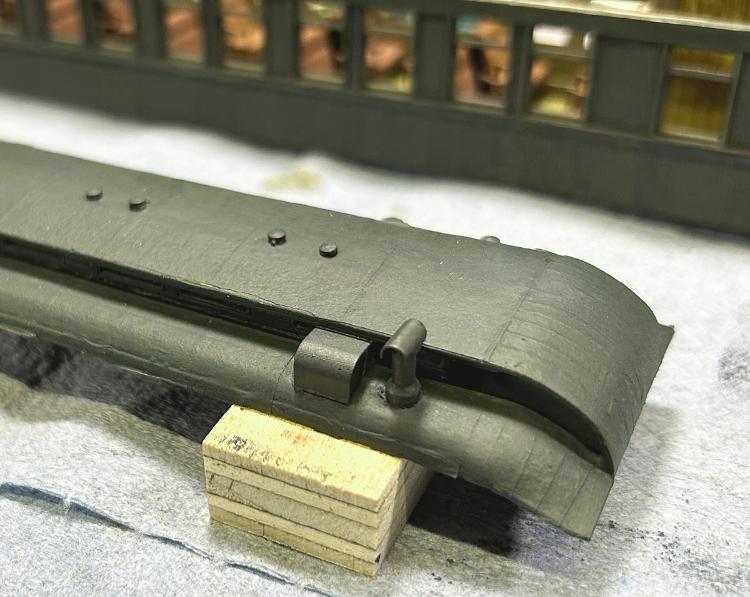
![]() I was planning to do a black roof but liked the green so doing that instead. I'm modeling a freelance line north out of Dillon with heavy C&S flavor (some Grande too). I like how it turned out, so there's that. Thanks for all the great information. Mike |
|
Administrator
|
Looks great, Mike. What color are you using? It looks very close to the Testors Model Master Dark Green I used.
I used a Semi Gloss overspray on the bodys of my cars with Dullcoat on the roofs. It's the same color, but the Dullcoat provides a different, faded texture. I did the same with the trucks. |
|
Not sure of the color fidelity of the photo but fairly close.
I used trusty Floquil Pullman Green for the coach body and Vallejo Model Air (brushed on) Camoflage Dark Green over black. Applied what used to be called Future (Pledge) floor finish for the body gloss finish, not too heavy. Good friend George Pierson turned me on to Modern Masters Dead Flat Varnish, I put that stuff on everything including the roof. Then a light dusting of PanPastels turqouise followed by a matte spray. Seems to nearly match the body but with a duller finish. Is it copper sheeting or painted canvas? I'll leave it to the viewer to decide, I like how it turned out... Mike |
| Free forum by Nabble | Edit this page |